AI Hits a Wall: Physical Bottlenecks, Memory Bubble, and the Oil Crisis Nobody's Watching
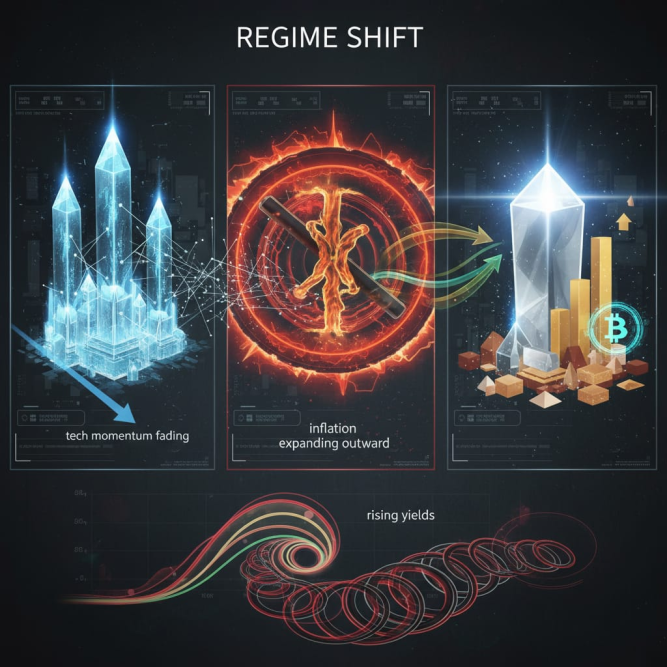
PTL Signal Institutional Analysis Report — Tuesday 26 May 2026. AI-generated earnings call analysis for informational and educational purposes only. Not financial advice. All trade ideas are hypothetical. Consult a licensed financial advisor before making any investment decisions.
// KEY TAKEAWAY
AI secular bull market is hitting physical infrastructure bottlenecks just as oil shortages and rate hike expectations threaten the most crowded trade in history. Momentum unwind is imminent.
The Headline vs The Real Story
The headline story is that AI buildout is unstoppable. $8 trillion in capex over eight years. Companies have the money and revenues are contracted.
The real story is harder to sit with.
We're only 12% through that buildout — and already hitting critical bottlenecks in power, memory, industrial capacity, and oil supply. This isn't software scaling. This is physical infrastructure colliding with hard physical constraints.
"By the end of this year, we will have only spent about 18% of what's expected. The physical system is already stressed before the largest dollar years even arrive."
That's the crux of the institutional analysis from this week's report. Let's break down each layer.
Theme 1: Physical Infrastructure Bottlenecks vs Software Expectations
The market is pricing AI like it scales like software. It doesn't.
"This is not a software capex. It is a physical world capex cycle. It needs HBM chips, racks, liquid cooling, copper, fiber, substations. If any of them aren't around, it is about the sequencing."
When one component is delayed, the whole chain stalls. You can't turn on a data centre without a substation. You can't run the racks without the cooling. You can't ship chips without the packaging capacity.
Only 12% through the buildout and we're already seeing delays, cost inflation, and supply shortages across multiple components. The revenue recognition risk for 2025–2026 is massive — companies can't deliver what's been contracted if the physical supply chain can't keep pace.
Trade implication: Fade parabolic memory and semi runs. Rotate to defensive infrastructure plays that benefit from bottlenecks rather than suffer from them.
Theme 2: Momentum Breakdown and Correlation Breaks
This is classic topping action — and the signals are everywhere.
Hyperscalers (Meta, Google, Amazon, Microsoft) — the actual spenders driving AI demand — are failing at key technical levels while semiconductor names stay elevated. Industrial momentum in Asia and Europe is breaking down while US semis hold up.
"We've had a huge run and I am seeing some global and sector correlation breaks which usually are warning sign that you should be careful."
"Historic breakdown in correlations between software and semi."
When the spenders are weakening while the receivers stay strong, it signals demand destruction beginning. Historically, this divergence precedes major unwinds by 3–6 months.
Hyperscalers broke below the 20-day moving average and have been flat for three weeks. That's not consolidation — that's distribution.
Theme 3: The Oil Supply Shock Nobody Is Pricing
This is the sleeper risk. Markets have completely ignored a building oil crisis.
The numbers are stark:
- US crude inventories fell 17.8 million barrels — the largest weekly fall since records began in 1982
- Gasoline inventories at the lowest since 2014
- Distillate inventories at the lowest since 2003
- China oil imports down 20–30%
- Strait of Hormuz remains unresolved
This hits AI directly. The buildout requires trucking materials, power generation, and industrial manufacturing — all energy-intensive. An oil spike inflates AI capex costs precisely when the physical supply chain is already stretched.
And the Fed? Six months ago they were pricing three rate cuts. Now they're pricing one rate hike. The macro environment has flipped — and tech valuations haven't adjusted.
Theme 4: Memory Bubble Formation
The memory sector is showing textbook late-cycle bubble characteristics.
The Roundhill DRAM ETF launched in April and gathered $10 billion in assets in two months. That's pure retail capitulation into momentum — the final phase of any bubble.
"Memory looks more bubble-like than Nvidia because memory does not have the same moat."
Micron is generating more quarterly profit than it generated in entire previous years combined. That's a cyclical peak, not a new normal. Memory is a bottleneck trade, not a platform trade. It's vulnerable to:
- AI efficiency improvements reducing memory intensity per compute unit
- Chinese supply competition entering at scale
- Customer cost sensitivity as compute costs spiral higher
The speaker has exited Micron. "I've bailed out of my Micron."
The Trade Structure
Here's how the institutional analysis structures the positioning:
Options Plays
QQQ Put Spread — Hedge extended tech exposure
Buy $460 puts, sell $440 puts, 45 DTE. Max profit $20/spread. Max loss $3–4. Breakeven $456–457.
MU Iron Condor — Range-bound before breakdown
Sell $120 calls/$100 puts, buy $130 calls/$90 puts. Max profit $6–8/spread. Max loss $2–4. Breakeven $106–$114.
VST Covered Call — Defensive AI income play
Long stock, sell $115 calls 60 DTE. Generates income while maintaining upside to $120.
Directional Trades
SHORT MU (Micron) — High conviction
Entry $105–110 on break below $110. Target $75–80. Stop $125. Risk/reward 2.5:1. Timeframe 3–6 months.
LONG VST (Vistra Energy) — Defensive AI infrastructure
Entry $88–92 on any pullback toward $90. Target $120–130. Stop $82. Risk/reward 3.5:1. Timeframe 6–12 months.
LONG USO (Oil Fund) — Supply shock play
Entry $70–73 on any dip below $72. Target $85–95. Stop $65. Risk/reward 2.8:1. Timeframe 3–6 months.
SHORT QQQ — Momentum unwind hedge
Entry $465–470. Target $425–440. Stop $485. Risk/reward 2.8:1. Timeframe 1–3 months.
PAIR TRADE: Long MRVL / Short MU — Platform vs commodity
Rotate from bubble-like memory to Marvell optical/interconnects. Target MU/MRVL ratio from 1.4 to 0.9. Risk/reward 4:1. Timeframe 6–9 months.
The Red Flags
Four critical warning signals from the analysis:
- [CRITICAL] Memory valuations at peak: Companies generating more quarterly profit than their historical annual totals — a textbook cyclical top signal.
- [CRITICAL] Oil inventory crisis ignored: "Largest weekly inventory fall since data available starting in 1982" — and sentiment just doesn't care.
- [MAJOR] Retail piling into DRAM ETF: $10B in 2 months into a narrow theme — classic late-cycle retail participation.
- [MAJOR] Hyperscalers breaking key technical levels: The spenders weakening while the receivers hold up historically signals demand destruction ahead.
The Historical Parallel: China 2002–2007
The analysis draws a direct comparison to the China infrastructure buildout of 2002–2007.
That cycle followed the same pattern: massive physical buildout driving commodity demand, bottlenecks creating cost inflation, retail piling into narrow themes, and then a cyclical correction within the broader secular trend before resuming.
"Remind us somewhat of the commodity bull market that occurred in China when China was building out from 2002 to 2007."
What happened next in that cycle: cost inflation led to demand destruction and a cyclical correction — then the secular trend resumed. The secular AI bull thesis stays intact. But the cyclical correction is coming first.
What This Means
The overall risk assessment is HIGH. Extended valuations combined with building macro pressures — rate hike pricing, oil supply shock, physical bottlenecks — create the conditions for a significant correction within the broader secular AI trend.
The recommended positioning is clear:
- Rotate from high-beta memory plays (Micron) to defensive AI names (Vistra, power producers)
- Hedge tech exposure with QQQ puts
- Establish oil long positions given record inventory draws
- Prepare for momentum unwind — but maintain the secular bull thesis
The speaker's tone is cautiously bearish near-term, bullish secular. The verbal cues are unambiguous: "we're extended," "I think it's going to be more than a one-week correction," "wouldn't surprise me if it started next week."
The secular AI thesis remains intact. $3.5 trillion in AI spending is forecast by 2027. Contracts are already signed. But the physical world doesn't scale at the speed of software — and the market hasn't priced that gap.
This is AI-generated institutional analysis for informational and educational purposes only — not financial advice. All trade ideas, price targets, options strategies, and risk assessments are hypothetical. Investment risk is real; you may lose some or all of your capital. Consult a licensed financial advisor before making any investment decisions. Past performance does not guarantee future results.
Lisa Tamati reports on macro strategy and markets at PTLsignal.com
// newsletter
Want more like this?
Join the PTL Signal newsletter. Weekly AI, Bitcoin & market analysis from Lisa Tamati.