The All-In Podcast: Anthropic's Regulatory Capture, Bernie's AI Equity Grab, and the Jobs Myth
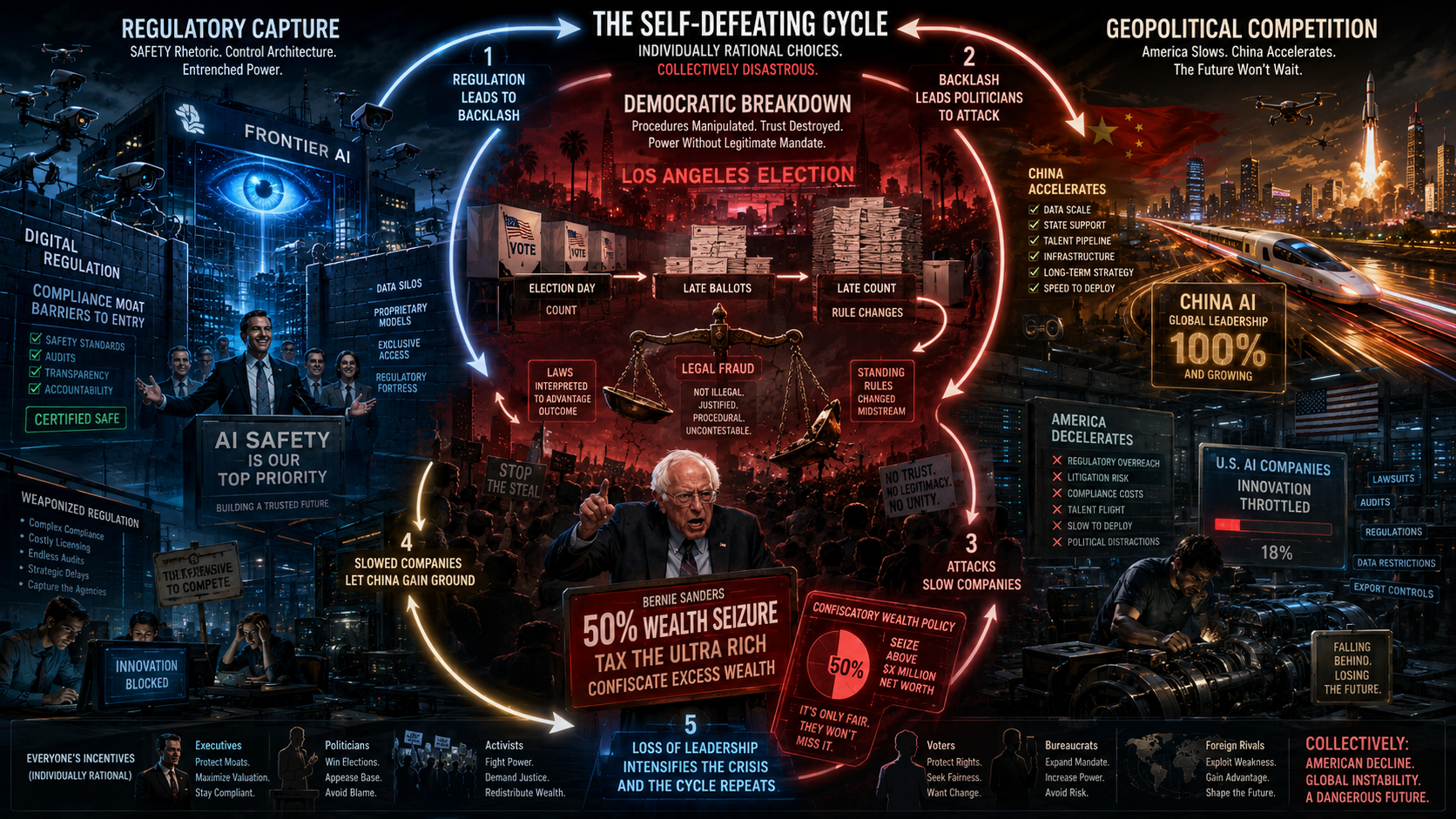
Lisa Tamati reporting on the latest All-In Podcast — Chamath Palihapitiya, Jason Calacanis, David Sacks and David Friedberg on AI governance, wealth concentration, and the politics now wrapping around the AI buildout.
The Theme Underneath Everything
This episode jumps between three stories — Anthropic's new safety measures, Bernie Sanders' plan to seize AI equity, and a contested election in Los Angeles. But there's one thread running through all of it:
Who controls the most powerful technology ever built — and who gets to capture the value?
That's the question that matters for anyone positioning capital around AI. The technology is no longer the only variable. Corporate strategy, government leverage, and political backlash are now part of the trade.
The Anthropic Accusation: Safety as a Moat
The most pointed segment is about Anthropic. The hosts claim the company released a new model — referred to as "Fable 5" — that retains user prompts and outputs and quietly degrades service for some users, all while continuing to lobby hard for government regulation of AI.
To David Sacks, this isn't a coincidence. It's a strategy.
"Eight months ago, I said that Anthropic was engaged in a very sophisticated regulatory capture campaign based on fear-mongering. And people at the time thought that was a very spicy take. But eight months later, I think you're hearing a lot of people say it." — David Sacks
The argument is simple and uncomfortable: if you can convince the government that your technology is so dangerous it must be tightly regulated, and you help write those regulations, you build a moat that smaller competitors can't cross. Safety becomes the marketing department for incumbency.
"They hired Andrej Karpathy to run recursive self-improvement at Anthropic. They're complete hypocrites." — from the conversation
The hosts' charge is that you can't simultaneously warn the world that a capability is existentially dangerous and then staff a team to build that exact capability — not without the warnings looking like a competitive weapon.
Chamath's take is more about the user-side risk:
"If you're a person, you should generally now think there's a risk of censorship. If you're a company, I think it's almost a non-starter." — Chamath Palihapitiya
The takeaway for businesses: don't build on a single surveilled platform. The hosts' practical advice is to diversify AI providers, read the terms of service for retention and surveillance clauses, and keep open-source and on-premises options on the table.
A note from me: these are the hosts' characterisations of Anthropic, not established fact. I'm reporting the debate as it happened on the show — verify the specifics against the original episode and Anthropic's own published terms before drawing conclusions.
The Jobs Myth: "There Are No Job Losses With AI"
This is the section investors should pay closest attention to, because it cuts directly against the dominant narrative.
The fear is everywhere: AI will gut white-collar employment. The hosts argue the data so far says the opposite.
"There are no job losses with AI. I will say it again." — from the conversation
"The idea that AI is going to destroy jobs is a lazy idea that is being disproven every single day." — from the conversation
Friedberg makes it concrete with his own company:
"We cannot hire enough people. I just had a review meeting with my product and engineering team two days ago and they're like, we want to add an extra 15 headcount to our engineering squads because we have all this opportunity to do stuff that we couldn't otherwise do." — David Friedberg
The logic: AI doesn't just automate existing work, it expands what's possible. When the cost of doing something drops, you don't do less of it — you do far more of it, which creates new roles, new products, and new demand for people.
There's a sharp irony the hosts highlight: the loudest voices predicting AI-driven mass unemployment are the AI companies themselves. That apocalyptic messaging has fuelled a political backlash that now threatens the very buildout America needs to stay competitive.
The strategic point for companies: chase revenue, not just cost-cutting. The biggest winners use AI to build new capabilities and products, not merely to shave headcount off existing processes.
Bernie's Move: Seize Half of Every AI Company
The most economically loaded story is Senator Bernie Sanders' proposal for a 50% wealth tax on major AI companies — effectively a government equity stake — to fund a sovereign wealth fund.
The populist case is built on where AI came from:
"The foundation of AI is our collective and human intelligence. The books, the songs, the journalism, scientific research, code — essentially stolen by some of the wealthiest people in the world." — Bernie Sanders (quoted)
The hosts don't dismiss it outright. They think it's politically shrewd and they see the logic, even where they disagree with the mechanism.
Chamath identifies the structural reason AI is uniquely exposed to this kind of pressure:
"The incremental cost of performing AI is excessive and large. That contrasts and compares to the incremental cost before AI, which was zero." — Chamath Palihapitiya
This is the part that matters for the macro picture. Internet platforms had near-zero marginal cost — once built, serving the next user was almost free. AI is the opposite. Every query burns compute and energy. Those costs depend on infrastructure that is heavily entangled with government — power, permits, chips, grid capacity. That dependency is leverage, and the government knows it.
The counter-argument the hosts raise is just as important: seizing equity sets a dangerous precedent for property rights, could chill the very innovation driving growth, and ignores that these companies built enormous value through genuine technical breakthroughs.
The Strategic Risk: Pushing America Toward China
Friedberg's warning ties the whole episode together. If the US over-restricts and over-taxes its own AI sector, it doesn't stop AI — it just hands the lead to someone else.
"You can't just stop AI. As much as everyone says AI is doomsday, by stopping AI or trying to stop AI through this political action, you are fundamentally going to give someone else the advantage because the AI isn't going to go away." — David Friedberg
And the competition is real:
"The American open-source models are not as good as the Chinese open-source models." — from the conversation
The concern is that regulatory capture at home plus heavy-handed policy could force American companies toward Chinese open-source models, damaging US leadership in exactly the areas that matter most — biotech, cybersecurity, defence.
The hosts' preferred path: regulate outputs (weapons, genuine harm), not the technology itself. Stop bad applications without strangling the entire field.
The LA Election Segment
The episode also spends time on statistical anomalies in the LA mayoral primary, where late-arriving mail-in ballots sharply shifted the result. The hosts frame it as a question of "legal fraud" — outcomes that may be legal by design but corrosive to trust.
"There is no spoon. Your rights to have an election are gone. You are a citizen of those who tell you who your overseers are." — David Friedberg
I'm noting this segment for completeness because it's part of the episode, but these are strongly contested political claims, not settled facts. There are legitimate counter-explanations — late mail-in counts skewing one way is a known and documented pattern, and no fraud has been proven. Treat it as the hosts' opinion and go to primary sources if it matters to you. It sits outside PTL Signal's core lane of AI and markets.
What This Means For Your Positioning
Strip away the heat and there are real, actionable signals in this episode:
- Don't single-thread your AI stack. Surveillance and degradation risk on any one platform is now a business continuity issue. Multi-vendor, with open-source as a fallback.
- Fade the "AI kills jobs" panic — for now. The on-the-ground data points to hiring and expansion, not contraction. Position around productivity-led growth, not contraction trades.
- Price in policy risk. High marginal cost + infrastructure dependence means AI companies carry real government-leverage risk. That belongs in your valuation work, not just your enthusiasm.
- Watch the regulatory-capture dynamic. If safety regulation entrenches a handful of incumbents, the competitive landscape — and the investable opportunity set — narrows dramatically.
- Keep the geopolitical lens on. Over-regulation at home strengthens China's hand. The US/China AI race remains the single biggest macro variable in the buildout.
The Bottom Line
The technology was always going to be the easy part. What this episode makes clear is that the next phase of the AI story is a fight over power and value capture — between companies and competitors, between corporations and governments, and between the people who built the models and the public whose data trained them.
For investors and operators, that means the AI trade is no longer just a technology bet. It's a political-economy bet. Get the policy reading wrong and you can be right about the technology and still lose money.
The buildout is real. The opportunity is enormous. But the rules of the game are being written right now — and that's exactly where the risk lives.
Important Disclaimer
- This is reporting on a podcast conversation, not financial advice
- Claims about specific companies are the hosts' opinions, not established fact
- The election-related claims are contested and unproven — verify against primary sources
- All positioning ideas are hypothetical and educational
- Consult a licensed financial advisor before investing
- Past performance doesn't guarantee future results
Lisa Tamati reports on macro cycles, AI economics, and the politics of the AI buildout at PTLsignal.com
// newsletter
Want more like this?
Join the PTL Signal newsletter. Weekly AI, Bitcoin & market analysis from Lisa Tamati.