Chai Discovery: The AI Breakthrough Turning Antibody Engineering Into Software
Lisa Tamati reporting on the No Priors podcast conversation with Josh Meyer and Jack Dent, co-founders of Chai Discovery.
A 100x Improvement in Drug Discovery (In One Year)
Josh Meyer and Jack Dent are describing something that shouldn't be possible yet.
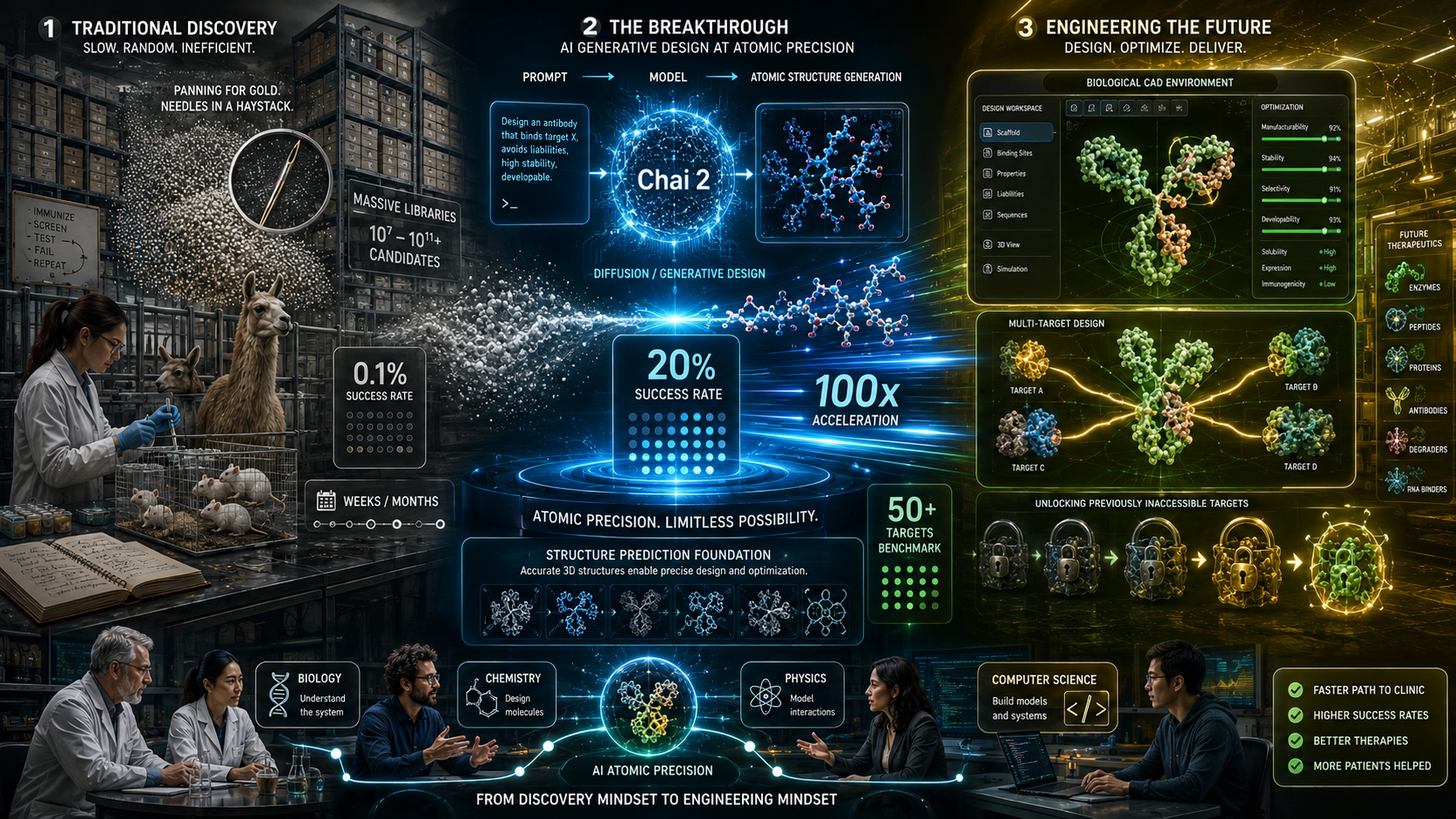
One year ago, the state-of-the-art computational approach to antibody discovery had a 0.1% success rate.
Chai 2, their new generative model released this week, achieves a 20% success rate.
That's 200 times better. In one year.
"We took a target, ran our models, asked the model to design an antibody. We then shipped that antibody to the lab. We have about a two-week validation cycle in the lab, and two weeks later we see that roughly 20% of these antibodies actually bind their targets in the intended way." — Josh Meyer
To put this in context: antibodies account for 50% of all recent drug approvals. Seven of the top 10 bestselling drugs globally are antibodies.
If you can design antibodies 100x faster and more effectively, you've fundamentally changed drug discovery.
From Discovery to Engineering: The Paradigm Shift
This is the critical reframing both founders emphasize:
Drug discovery has always been a discovery problem. You search through millions or billions of compounds looking for one that works. It's panning for gold.
Traditional approaches:
- Inject mice or llamas with antigens
- Wait weeks for them to get sick
- Extract blood plasma
- Hope you find one antibody that works
Chai's approach:
- Prompt a generative model: "Design an antibody that binds to this target"
- The model generates candidates in seconds
- Ship 20 to the lab
- 4 bind successfully
- Move to the next iteration
"We made a bet when we started the company that structure prediction was going to get a lot better. And we were right. We also made a bet that diffusion models and language models would give us new capabilities in design. And we were right." — Josh Meyer
The shift from discovery to engineering is profound. Engineering is reproducible, scalable, software-driven. Discovery is not.
The Technical Breakthrough: Atomic-Level Precision
Here's what's actually happening under the hood:
Structure prediction (Chai 1, open-sourced):
- Takes a protein sequence
- Predicts its 3D structure with atomic-level precision
- Error rate: less than the width of one atom
Design model (Chai 2):
- Takes a target protein (the "lock")
- Generates a new protein sequence (the "key") that binds to it
- Models atomic placement in 3D space
- Reasons probabilistically about molecular interactions
"You can think of structure prediction as the 'imagine' moment for the field. With structure prediction, we're asking a model to go from sequence to predicted structure. Design is much more like a generative task — like Midjourney for molecules." — Jack Dent
The model is learning something fundamental about how molecules interact. It can generalize to targets it's never seen before, even targets that are very different from training data.
In their paper, they tested on 50+ targets with only 70% sequence similarity to anything in training. The success rate stayed the same: 20%.
Then they pushed harder — testing on targets with only 25% sequence similarity. Still 20%.
"The model doesn't think in terms of protein families. It's learned something very fundamental about molecular interactions." — Josh Meyer
Why This Matters: Access to Previously Impossible Targets
The speed improvement (faster discovery) is obvious. But the founders care more about accessibility.
There are entire classes of drug targets that were previously inaccessible because the discovery process was too slow or too expensive.
"We can now solve problems that just weren't even reachable with traditional methods. The failure mode of the models is going to be different than the failure mode in the lab today. And that's really where the sweet spot is — problems that were impossible before." — Josh Meyer
Example they share:
- A partner company had been working on a target for years
- 5-10 people, $5-10 million spent
- They wanted an antibody that works against BOTH human and monkey versions of a protein (critical for animal testing)
- Traditional methods couldn't solve it
- Chai 2 solved it in 14 design attempts
- 4 hits to human, 1 hit to monkey, 1 overlapping hit
"That one molecule now allows them to move forward with the program. The difference between requiring an injection versus subcutaneous dosing for a patient — that's the kind of engineering outcome this enables." — Jack Dent
The 50-Target Benchmark: Why Scale Matters
They didn't publish results on 1-3 targets (like most papers). They published on 50+.
Why? Because they wanted to treat this as an engineering problem, not a research novelty.
"If you had a new LLM paper and you said 'I solved one problem really well,' that's not impressive. You need a real benchmark at scale. You need to convince yourself the system is actually generalizable." — Josh Meyer
Selection process:
- Scraped vendor catalogs to find targets in stock
- Ensured targets weren't in training data
- Removed anything with >70% sequence similarity
- Made sure they could turn around experiments quickly
"We just ordered all of these designs at the same time because we wanted to move fast. From an engineering perspective, not a biology perspective. These weren't necessarily designed to be therapeutically useful — just to assess the model." — Josh Meyer
The Defensibility Problem: Software, Not Just Model
Here's where Jack's experience at Stripe becomes critical:
A generative model is not a product. It's a component of a product.
The real defensibility is in the product and platform around the model.
Their investment strategy:
- Further therapeutic property optimization — The 20% hit rate is binding affinity. But drugs need manufacturability, stability, immunogenicity, PK/PD properties
- Competitive design — Design molecules that hit multiple targets simultaneously, or hit one target while avoiding another
- Software and interface layer — Turning biology from "how do I prompt the model right?" to a full CAD suite for molecules
"We released Chai 1 as a model. Chai 2 is a lot more than a model. It's a product. It's a pipeline. Structure prediction is straightforward — you put in sequences, get out structures. Design is different. A scientist doesn't want to write code to specify prompts. They want a thoughtful software interface." — Jack Dent
The Future: CAD Suite for Biology
Josh and Jack are describing a future where:
"We'll have a computer-aided design suite for molecules the way we have Solidworks for mechanical engineering or Photoshop for creative work. The ability to design, program, and understand interactions between atoms and molecules at a fundamental level — those implications are vast." — Josh Meyer
Roadmap:
- Next 1-2 years: Optimize therapeutic properties (manufacturability, stability, selectivity)
- 2-5 years: Design entire drug candidates in zero-shot
- 5+ years: Multi-target design, advanced antibody formats (biparatopic), enzyme design, peptide design
"Once you see the 20% hit rate, there's no reason other classes of molecules can't achieve similar or higher rates. We've already shown 70% on mini-proteins with tight-binding affinities." — Josh Meyer
Why "Bullish on Biotech" Right Now
Biotech has been in a bear market for 5 years. XBI (biotech ETF) is down. Capital is scarce. The macro is brutal.
"There is a lot of doom and gloom in biotech right now. But it's moments like this — breakthroughs like this — that give us reasons for immense optimism not just in terms of improving timelines and reducing costs, but in enabling entirely new products." — Josh Meyer
The reasoning:
- Success rates going from 0.1% → 20% → (likely) 50%+ over next 2-3 years
- Entire new classes of targets become accessible
- Risk profile of drug discovery drops dramatically
- Clinical risk remains, but discovery risk collapses
- This unlocks programs that were previously considered too risky
"I think if you see our mini-protein results, we're close to 70% on those with picomolar affinities. Who's to say other molecule classes can't achieve that? Once you have that level of precision, you enter an era where drug design becomes engineering." — Josh Meyer
The Team and Culture: Engineering Rigor in Deep Learning
Jack emphasizes something unusual for a research-focused biotech company: engineering rigor.
Most deep learning code bases are messy. Bugs can hide for weeks before showing up in a training run.
Chai's practice:
- Unit tests for everything
- Rigorous code review
- Platform investment from day one
- Modularity and simplicity as cultural values
"I've seen million-dollar training runs fail because of a bug introduced weeks earlier. We've literally had to do binary search on our Git history to find bugs. Those experiences make you realize engineering rigor isn't optional — it's essential." — Jack Dent
Team composition:
- Josh: Chemistry degree (not CS)
- Alex: Physics PhD
- Matt McPartland, Jack Bo: co-founders
- ~12 people total
- Most don't have CS degrees
- Everyone is "stellar engineer"
"This work is so interdisciplinary that you need breadth across biology, chemistry, physics, AI, and computer science. Small but mighty teams can go really far in AI right now." — Jack Dent
What Antibody Engineers Should Do Right Now
If you're an antibody engineer today:
- Get access to Chai 2 — The paradigm is shifting. Get hands-on with the model immediately.
- Learn to write better prompts — Antibody engineering is becoming expert prompt engineering. What epitope should you target? How do you specify complex constraints? These become the new skills.
- Dream bigger — The painstaking, slow feedback loops of traditional wet lab work are ending. What problems were unsolvable before? What creative approaches does this unlock?
"The conversations we've had with antibody engineers have shifted dramatically. A few weeks ago, people said 'this is maybe 3-5 years away.' Now they've seen what Chai 2 does and they fall off their chair. The creativity is being unlocked because people can finally see what's possible." — Josh Meyer
The Honest Uncertainties
Both founders are clear about what remains unproven:
- Other therapeutic properties — Binding affinity is solved. Manufacturability, stability, immunogenicity, PK/PD? Still needs work.
- Clinical translation — Discovery risk is gone. Clinical risk remains massive.
- Capital and regulatory — Biotech still requires massive capital and regulatory patience. This doesn't solve that.
- Other molecule classes — Antibodies are working. Enzymes, peptides, small molecules? Not yet proven at this scale.
- Market dynamics — Whether the biotech industry can actually capitalize on this breakthrough given capital constraints and macro headwinds.
"This is really just the tip of the iceberg. There's tons of clinical risk, capital requirements, regulatory challenges. But we have a lot of reason to be optimistic about the progress this represents." — Josh Meyer
The Bottom Line
Chai Discovery is demonstrating that AI can solve biological problems at a fundamental level.
Not as an incremental improvement. As a paradigm shift.
From 0.1% to 20% success rate in a year means:
- Targets that were economically inaccessible are now accessible
- Drug discovery becomes engineering, not discovery
- Biotech enters a new era of possibility
The question isn't whether this works. They've proven it works.
The question is: can the biotech industry move fast enough to capitalize on it?
Given the capital constraints, regulatory timelines, and clinical risk that still exist, that's the real test.
But for antibody engineers, researchers, and biotech investors who've been pessimistic for 5 years, this is the signal they've been waiting for.
Bullish on biotech. For real this time.
Important Disclaimer
- This is reporting on a podcast conversation, not financial or medical advice
- Success-rate figures are the founders' own reported results, not independently verified
- Discovery progress does not remove clinical, regulatory, or capital risk
- All positioning ideas are hypothetical and educational
- Consult a licensed financial advisor before investing
- Past performance doesn't guarantee future results
Lisa Tamati reports on AI breakthroughs, biotech transformation, and the future of drug discovery at PTLsignal.com
// newsletter
Want more like this?
Join the PTL Signal newsletter. Weekly AI, Bitcoin & market analysis from Lisa Tamati.