Two of the Smartest Investors in AI Just Made the Same Call — Here's What They're Buying
When two of the sharpest minds in markets independently arrive at the same conclusion from completely different analytical frameworks, it's worth paying attention. That just happened.
Leopold Aschenbrenner's Q1 2026 13F filing dropped on May 18th and it sent shockwaves through fintwit. The 25-year-old former OpenAI researcher — who turned $225 million into $13.7 billion in under 18 months — has taken an $8.5 billion short position against the entire AI semiconductor stack. NVIDIA, Broadcom, AMD, ASML, Micron, Intel, Oracle, Corning, Taiwan Semi, and the SMH ETF as a wrapper. All puts.
Meanwhile, Jordi Visser — the former CIO of Weiss Multi-Strategy Advisors — spent his latest weekly macro update laying out an almost identical thesis from a completely different angle. He's fully exited his semiconductor positions including a 5–8x Micron trade, and he's rotating the proceeds into silver, Bitcoin, and commodities.
Two very different investors. Two very different methodologies. The same conclusion: the semiconductor design layer is overcrowded, and the next wave of returns is somewhere else entirely.
What They Agree On
The convergence is striking, so let's start there.
Neither one is calling AI a bubble. Leopold's core thesis — that AGI is a 2027 event requiring industrial-scale infrastructure — hasn't changed. Jordi explicitly says the $90 trillion AI buildout will happen and that semiconductor revenue hitting $1.3 trillion in 2026 is justified. The earnings are real. The demand is real. The capex is real.
The problem is the price action. Jordi frames it through his proprietary exhaustion model, which categorises stocks into tiers based on how far and fast they've moved. Stocks in his extreme exhaustion tier are averaging 4.1x moves — right at the historical reversal zone. Leopold frames it through valuation, arguing chip design companies are overcrowded trades priced for a world that no longer exists. Different routes, same destination.
Both see the bottleneck moving from chips to electrons. Leopold's entire long book is physical infrastructure: Bloom Energy, power companies, Bitcoin miners with grid access, NeoCloud providers like CoreWeave. Jordi's rotation is into commodities, silver, and Bitcoin — all expressions of the same thesis that the physical world is now the constraint.
And both see institutional momentum chasers providing exit liquidity. Jordi cites Goldman's trading desk reporting sovereign wealth funds panic-buying AI names since May. Leopold's put book is effectively a bet that these late-cycle buyers are the last ones in.
Where They Disagree
The differences matter too, and the biggest one is NVIDIA.
Leopold has $1.9 billion in combined NVDA puts. It's his largest short position. But Jordi explicitly does not see NVIDIA as stretched. He calls it "the winner and king" and shows it outperforming every Mag 7 name since 2018. Jordi's exhaustion model flags the broader semiconductor complex — the 9-baggers in months, the Korean names, the power semis that ripped in less than a month — but he separates NVIDIA from the pack. NVIDIA earnings on May 28 will likely determine who's right.
The other key divergence is memory. Jordi's DRAM analysis shows pricing momentum turning negative — historically a leading indicator for semiconductor underperformance. Leopold, on the other hand, has SanDisk as his second-largest long and holds collar positions on Micron rather than a pure short. He seems to think NAND flash (what SanDisk makes — storage for AI training data, inference checkpoints, agent memory) is a different story from DRAM. They could both be right if you separate the two.
Jordi also brings something Leopold's filing doesn't address: the Strait of Hormuz. It's still shut, and Jordi argues this creates a production constraint on semiconductor manufacturing that nobody is modelling. Every component in a data centre rack depends on something flowing through the Strait — petrochemicals, sulfuric acid, cooling compounds. If Jordi is right, the semiconductor correction could come faster and harder than Leopold's options positions even need.
What They're Buying
So where is the money going? Here's where both theses point.
Bloom Energy (BE) is Leopold's largest holding at $878 million. The company makes solid oxide fuel cells for on-site data centre power — deployable in months rather than waiting years for grid connections. Oracle just signed a 2.8 GW partnership. Q1 revenue came in at $751 million, up 130% year-over-year, crushing estimates by 41%. Full-year guidance was raised to $3.4–3.8 billion. The stock hit $310 before pulling back to around $256. The thesis is bulletproof — power is the constraint, Bloom solves it — but the stock has done a 15-bagger in a year. The long-term moving average sits around $220, and that's probably a better entry if you're looking to build a position.
CoreWeave (CRWV) is the NeoCloud play — GPU cloud infrastructure with multi-billion dollar contracts signed with Meta, Anthropic, and OpenAI. What makes CoreWeave interesting is that it owns both the compute AND the power access. If semis correct but infrastructure demand holds, CoreWeave benefits from cheaper GPU procurement while maintaining pricing power. Revenue backlog is $99.4 billion with a five-year average contract duration. NVIDIA invested an additional $2 billion in shares during Q1. Trading around $104, down 44% from highs, with 33 analysts giving it a Strong Buy and an average target of $130. The risk is the $25 billion debt load and ongoing operating losses. Scale in on weakness rather than chasing.
SanDisk (SNDK) is Leopold's second-largest position at $724 million and the purest expression of the NAND memory thesis. Q3 revenue came in at $5.95 billion, 3.5 times the prior year, crushing consensus. The company has signed $42 billion in long-term supply agreements and Gartner forecasts NAND prices to increase 234% in 2026 with the memory crunch lasting until 2028. The caveat: this stock is up 4,000% in a year. NAND cycles are brutal when they turn, and Samsung and SK Hynix will eventually add capacity. Sizing matters here — this is not a name to go heavy on at current levels.
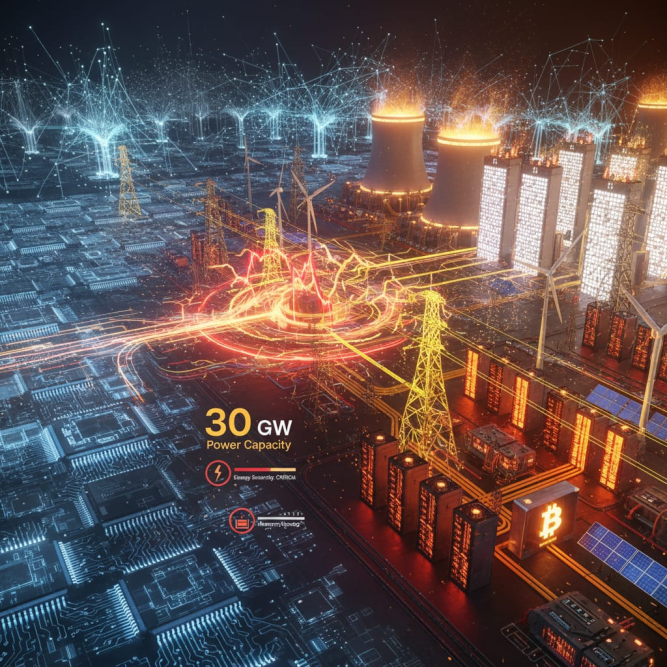
Bitcoin miners pivoting to AI infrastructure are the least obvious but potentially most compelling trade. Leopold has massive positions across IREN ($401M), Core Scientific ($389M), Riot Platforms ($142M), CleanSpark ($105M), and several smaller miners. The thesis is simple: these companies own high-density power sites with existing grid connections that AI companies can't replicate quickly. US Bitcoin miners are projected to bring 30 gigawatts of interconnected power capacity online this year — roughly equal to Microsoft, Google, Amazon, and Meta combined.
IREN just signed a $3.4 billion AI cloud contract with NVIDIA and a $9.7 billion deal with Microsoft. NVIDIA is investing directly with the right to buy 30 million shares at $70. Trading around $53 with analyst targets averaging $66. The risk is execution — they just raised $3 billion in convertible notes and the transition from mining to AI compute is technically complex.
Riot Platforms is earlier in the pivot but arguably cheaper. AMD just doubled its capacity lease at Riot's Rockdale, Texas campus, and activist investor Starboard Value publicly valued the AI pivot at up to $21 billion versus Riot's current $6.3 billion market cap. Trading around $23 with a Strong Buy consensus.
Bitcoin and silver round out the rotation. Jordi's macro framework points to both: negative real yields returning, CPI breaking above three-month bills, and the commodity scarcity trade intensifying. He's watching Dogecoin as the signal for when retail re-engages with crypto — when DOGE breaks out, that's when the next BTC parabola accelerates. His timeline is 6–12 months. Both are patience trades — accumulate on weakness, don't chase.
The Names They're Cautious On
The semiconductor design layer is the common target. Leopold has puts across ASML, AMD ($969M), Broadcom ($1B), and the SMH ETF ($2B). Jordi shows candlestick reversal patterns across Korean, French, and Japanese semiconductor names with his exhaustion model flagging extreme readings across the AI complex.
The one name they disagree on is NVIDIA. Leopold's $1.9 billion combined short is his largest position. Jordi still calls it the king. NVIDIA earnings on May 28 is the event that will likely determine who's right — if guidance comes in above $78 billion for next quarter, Leopold's puts take a hit. If there's any mention of supply chain constraints or production bottlenecks, Jordi's thesis gets validated and the broader semiconductor correction accelerates.
The Bottom Line
Two of the sharpest investors in the AI space have independently rotated from semiconductor design names into physical infrastructure — power, data centres, memory, and crypto. The trades they agree on carry the highest conviction. The trade they disagree on — NVIDIA — is the one to watch most closely.
The semiconductor correction may come from Hormuz supply disruptions, DRAM pricing momentum turning negative, institutional momentum exhaustion, or some combination. But both investors are clear: the AI buildout is a $90 trillion secular trend that is not going away. They're not calling the end of AI. They're calling the rotation within it.
Position for the next wave, not the last one.
This analysis is based on Jordi Visser's weekly macro update and Leopold Aschenbrenner's Q1 2026 13F filing (Situational Awareness LP, filed May 18, 2026). PTL Signal tracks Jordi's Scarcity framework at ptlsignal.com/visser.
For informational purposes only. Not financial advice. Do your own research.
// newsletter
Want more like this?
Join the PTL Signal newsletter. Weekly AI, Bitcoin & market analysis from Lisa Tamati.