Visser: AI Is a Commodity Supercycle Disguised as a Tech Trade — and Bitcoin Is the Funding Rate for AI Agents
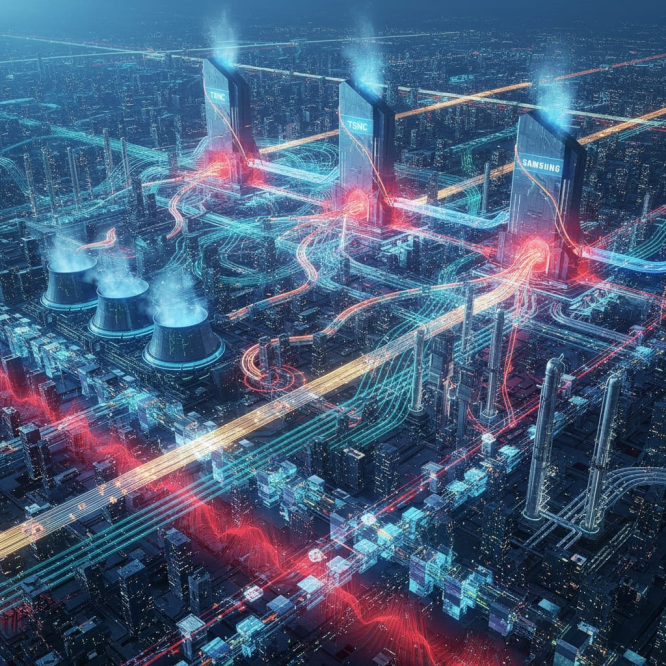
Lisa Tamati reporting on Jordi Visser's latest institutional analysis.
For informational and educational purposes only — not financial advice. All trade ideas are hypothetical. Consult a licensed financial advisor before making investment decisions.
The Key Takeaway
AI demand explosion has created unprecedented bottlenecks in physical infrastructure, driving a commodity supercycle disguised as a tech trade — while Bitcoin emerges as the funding rate for AI agents who only care about making money, not being right.
That's Jordi Visser's thesis in one sentence. The rest of this analysis unpacks why it matters and what to do about it.
AI Is a Macro Trade, Not a Tech Trade
This is the reframe that changes everything.
Most investors are playing AI by picking the best software companies — Nvidia, Microsoft, Google. Visser says that's the wrong frame entirely.
"AI is a macro trade. It is not a technology trade. You have to understand liquid cooling. You have to understand chemicals. You have to understand power."
The thesis: $90 trillion is flowing into hardware infrastructure that has been systematically underinvested for decades. Only three foundries control global semiconductor production — TSMC, Samsung, and Intel. AI has created demand that none of them planned for.
"This is $90 trillion that's getting washed into hardware things that have been underinvested where bottlenecks and shortages show up in a matter of months."
We're in inning one of a 20-year buildout. AI IQ has jumped from 100 to 160 — Einstein-level — in three years. There are now billions of AI agents consuming tokens like humans consume food. But there aren't enough semiconductors to feed them.
The real opportunity isn't in the AI models themselves. It's in the physical constraints: cooling, chemicals, power, optical fiber — everything required for 24/7 AI agent operation.
Why Institutions Are Missing It
Here's why the trade persists despite being obvious to anyone paying attention.
Hedge funds face monthly redemption cycles and drawdown limits. If you put a 10% position in something that can fall 50% in a month, you can have a drawdown that wipes your capital. So they don't size in properly.
Pension funds and insurance companies have a different problem. Their benchmarks don't accommodate 70–80% volatility names. Their job, as Visser puts it, "is to not get fired." So they call it a bubble and wait.
This institutional resistance creates persistent mispricing. The people who understand the thesis can't size into it. The people who can size into it don't understand it.
That gap is the opportunity.
AI Agents Are New Economic Actors
This is where the thesis gets genuinely strange — and genuinely important.
"AI agents, you know what their goal is? To make money. That's it. Not to be right."
Unlike humans, AI agents have no loss aversion, no ego, no memory of drawdown. They won't avoid Bitcoin because they "missed it." They'll buy whatever is working, purely because it's working.
Think about what that means for market structure. Traditional bubbles rely on human psychology — fear, greed, capitulation. Emotionless AI agents exit positions at mathematical inflection points, not at emotional extremes. This creates speed crashes: markets that move faster both up and down, with shorter correction durations.
"There'll be billions of 160 IQ agents running around. So that means a billion Einsteins — which means the Manhattan Project on steroids is basically going on."
For crypto specifically, this is structurally bullish. AI agents won't carry the emotional baggage that keeps institutional money sidelined from Bitcoin. They'll buy the obvious winner when it's the obvious winner.
Bitcoin as the Funding Rate of the Future
Visser's Bitcoin thesis isn't about store of value or digital gold. It's operational.
AI agents need a payment mechanism. They need a way to transact autonomously — to pay for compute, to allocate resources, to execute across platforms without human intermediaries. Fiat doesn't work for autonomous agents operating at machine speed. Bitcoin and tokenised assets do.
Layer that on top of the macro setup: Visser expects headline US inflation above 4% while three-month bills sit below 4%. That's negative real yields. And negative real yields are historically when Bitcoin has generated all of its returns.
"I think the theme that will dominate all investments in the second half of the year will not be the AI buildout story. It will be negative real yields."
The convergence of tokenisation, stablecoin adoption, and declining Bitcoin volatility (now matching energy stocks) sets up a powerful second half for crypto.
The Sector Rotation: Where Visser Is Moving
Visser sold 2/3 of his DRAM positions after a 6x gain. He's rotating into:
- Silver — positioned to triple on negative real yields and industrial AI demand
- Chemical names — 24/7 AI agent operation requires specialised cooling and chemical processes that are just beginning to be understood as a bottleneck
- Power infrastructure — data centre power requirements are growing faster than the grid can handle
- Bitcoin and Ethereum — for the H2 tokenisation and negative real yields play
He's shorting SaaS — AI agents are reducing software licensing needs and traditional software models are breaking down.
The Specific Trade Ideas (Hypothetical)
MRVL (Marvell Technology) — High conviction. Optics semiconductor play early in the AI infrastructure buildout, trading at a 0.2 PEG ratio with potential to double. Entry zone $155–165, target $320, stop $135.
ENTG (Entegris) — Medium conviction. Chemical company supporting semiconductor manufacturing, early stage of AI infrastructure chemical needs. Entry zone $125–135, target $250.
PSTG (Pure Storage) — Medium conviction. Data storage infrastructure for AI agent workloads. Entry zone $50–55, target $100.
IFNNY (Infineon Technologies) — Medium conviction. Power semiconductor play, breaking out of a 15-year consolidation pattern following the Intel template. Entry zone €35–40, target €70.
BTC-USD — High conviction. Bitcoin as the funding rate of the future, positioned for negative real yields and institutional adoption. Entry zone $70K–$85K, target $150K.
SLV (Silver ETF) — High conviction. Silver positioned to triple on negative real yields and industrial demand from AI infrastructure. Entry $27–30, target $85, 7:1 risk/reward.
The Historical Parallel: 1970s Oil Crisis
Visser draws an explicit analogy to the 1970s oil crisis — a commodity supercycle that emerged alongside technological advancement.
Physical constraints drove massive returns in resource extraction and infrastructure companies while the primary tech plays plateaued. The same dynamic is playing out now: focus is shifting from primary AI beneficiaries (Nvidia, Microsoft) to secondary infrastructure — cooling, chemicals, power, optical fiber.
The secondary plays could outperform primary AI names as supply constraints persist through 2028.
The second historical parallel: institutional capitulation. In 1995–1999, institutions called the internet a bubble until they were forced to participate. The final parabolic phase was driven by institutional FOMO. Probability of that repeating here: 60%, with similar resistance patterns already visible.
The Risks Worth Watching
AI efficiency improvements could reduce infrastructure demand faster than expected. If models become dramatically more efficient, the token consumption growth story slows.
China-US tensions disrupting semiconductor supply chains is rated high probability, high impact. Three foundries controlling global production is an extreme concentration risk.
Regulatory intervention slowing the AI buildout is medium probability but high impact — focus on defensive infrastructure plays rather than aggressive AI companies as a hedge.
What This Means
Visser's view is that most money managers lack domain experience in both AI and macro simultaneously. They can't connect the token consumption explosion to the chemical supply chain or the power grid constraint. That's where the mispricing lives.
"This is the biggest opportunity of our lifetimes."
The framework: AI isn't a software story. It's a physical scarcity story. The bottlenecks are in cooling, chemicals, power, and optical fiber — not in models or algorithms. The institutions that understand this are still months away from acting on it. The window to position ahead of institutional capitulation is now.
This is analysis of an investor's stated thesis and positioning, not financial advice. All trade ideas are hypothetical and educational. This analysis may contain errors or misinterpretations. Past performance does not guarantee future results. Verify claims from original sources. Consult a licensed financial advisor before making investment decisions.
Lisa Tamati is a professional ultra-endurance athlete, author, and host of the Pushing the Limits Podcast. She runs a longevity health practice and supplement company from Taranaki, New Zealand.
// newsletter
Want more like this?
Join the PTL Signal newsletter. Weekly AI, Bitcoin & market analysis from Lisa Tamati.