The Exponential Future: Abundance vs. Politics — Friedberg & Williamson on Humanity's Next Chapter
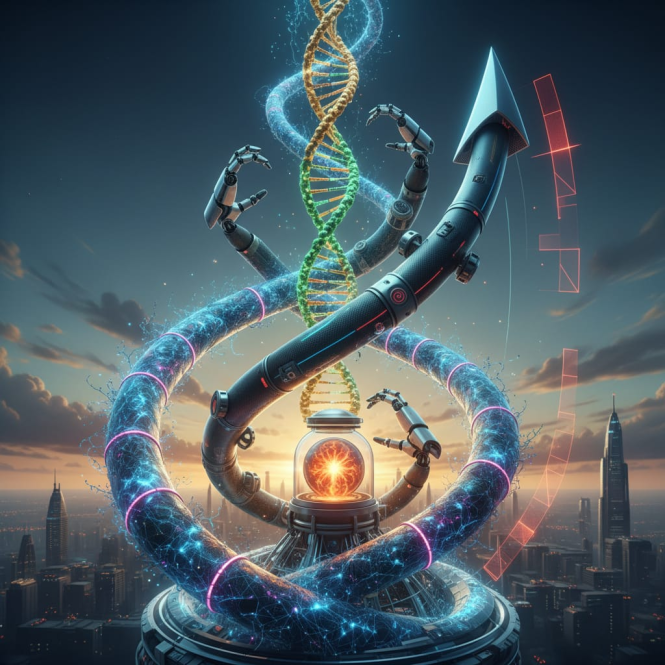
Reporting on David Friedberg & Chris Williamson on exponential technology, political threats to innovation, and the choice between abundance and stagnation.
When David Friedberg, CEO of Ohalo and co-host of the All-In Podcast, sat down with Chris Williamson on the Modern Wisdom podcast, they tackled a question that defines our moment: Is humanity heading toward unprecedented abundance, or are we about to sabotage ourselves?
The answer, according to Friedberg, hinges on a single variable: politics.
"There's an extraordinary compounding effect happening in technology generally," Friedberg explains. "Digitization of the physical world, and then our ability to make predictions about the future and engineer a different future."
But here's the rub. While technological innovation races forward exponentially, government overreach, wealth taxes, and fear-based politics — particularly in California and the broader West — threaten to undermine the very innovation that could solve humanity's greatest challenges.
It's a tension that defines our era. And it demands attention.
The Exponential Convergence: When Multiple Breakthroughs Collide
We live in a uniquely compressed moment. AI, robotics, fusion energy, biotechnology, and space colonization are not developing in isolation — they're converging.
Consider fusion energy. Friedberg notes that "you can use a swimming pool-sized amount of ocean water to make all the electricity needed for an entire year for the planet Earth." This isn't speculation; it's physics.
Or robotics. Friedberg envisions a world where "someone puts a robot in their garage, and this robot can do anything, works 24 hours a day. That robot's now your employee." Why? Because the marginal cost of robotics is approaching zero.
And then there's age reversal. Through Yamanaka factors and epigenetic reprogramming, researchers have already reversed biological aging in mice to the equivalent of 200+ years old in humans. The cocktail of molecules needed to reset cells' epigenetic programming is being discovered faster than ever.
When these breakthroughs compound simultaneously, the result isn't incremental progress — it's transformation.
Technology Diffusion: Why Monopolies Aren't Forever
One of Friedberg's most compelling arguments addresses the common fear about AI and robotics: Won't massive corporations monopolize these technologies?
His answer: No, because history shows us a clear pattern.
"All technology shifts go through a phase of diffusion," he explains. "We've already seen in just the last couple of weeks this insane shift in AI where people don't have to run models in the cloud anymore. They can run models on their desktop at home."
This is crucial. Every transformative technology — from electricity to automobiles to the internet — follows the same arc:
- Centralized Control — The technology starts with powerful institutions.
- Gradual Diffusion — Access spreads as costs fall and adoption accelerates.
- Democratization — The technology becomes accessible to everyone.
We're already in the diffusion phase with AI. This means:
- Everyone will have AI tools at their fingertips.
- Everyone will have access to robotic manufacturing capacity.
- Everyone will be able to start a small business, backed by AI and automation.
"When you think about it in that context, which is that this diffusion of technology enables everyone to get value from it — so, everyone will have a robot, everyone will be able to have a small business."
The East-West Divide: A Dangerous Competitive Dynamic
Here's where the conversation takes a sobering turn.
In the East, countries like China embrace technological advancement because they have more to gain than to lose. China's GDP per capita skyrocketed from $3,000 to $30,000 in just a couple of years. Imagine seeing the average person's income in an entire country go up by 10x.
In the West, we resist change because we have more to lose than to gain. We're afraid of disruption. We're afraid of losing existing advantages.
This creates a dangerous competitive dynamic. While Eastern nations race forward, Western nations — particularly the US — are retreating into fear-based politics, regulatory burden, and wealth redistribution policies that discourage the very innovation we need.
Friedberg doesn't mince words: "California set up a system where we created the highest tax rate in the country because of all the success in Silicon Valley, and use that to fund a bunch of nonsense."
The result? Brain drain. Regulatory paralysis. A culture that punishes success rather than rewards it.
The Political Threat: Private Property Rights Under Assault
The deepest concern Friedberg raises isn't about technology at all — it's about governance.
"By degrading private property rights, we are setting a precedent in the United States that is the foundation of why the United States was set up in the first place."
Wealth taxes, forced wealth redistribution, and ever-increasing government control threaten the very incentive structure that drives innovation. When 51% of the population can vote themselves what the other 49% has, "that's the end state of this — it eats itself. And that's socialism."
This isn't abstract philosophy. It's the difference between a civilization that innovates and one that stagnates.
Age Reversal: Living Long Enough to See the Future
Among the breakthrough technologies Friedberg discusses, age reversal stands out as personally transformative.
Yamanaka factors and epigenetic reprogramming aren't theoretical. They're being discovered and refined in real time. The implication is profound: we may be approaching longevity escape velocity — a point where advances in life extension outpace aging, allowing people to live indefinitely healthy lives.
"We are now discovering not just the four proteins, but a whole bunch of other little molecules that we can put into a cocktail," Friedberg explains. "It will get into our cells and it will reset the epigenetic of that cell to make it young again."
This changes everything. It means the people alive today might be among the first to experience radically extended healthspans. It also means prioritizing longevity practices — fitness, nutrition, stress management — isn't vanity. It's insurance for a future that may be radically different from our past.
The Moon as Economic Opportunity
In typical Friedberg fashion, he identifies an underdeveloped opportunity: the moon.
The moon isn't a symbolic destination. It's an economic powerhouse. By manufacturing materials on the moon for Mars colonization, we could reduce energy costs by 100x or more. This transforms the economics of space exploration entirely.
"I think the moon is probably one of these more under-recognized Silicon Valley kinds of grand economic opportunities," Friedberg notes.
It's a perfect example of how technological convergence creates new frontiers. Space isn't just about exploration anymore — it's about manufacturing, resource extraction, and planetary redundancy.
Why Humans Fear the Future (Even When It's Good)
Chris Williamson pushes back thoughtfully: Why do people resist change that's objectively good for them?
Friedberg's answer is rooted in evolutionary psychology.
"I think people have had a tendency to be worried about the future because humans are programmed to be that way. We always were worried about some predator coming around the corner eating us."
This survival mechanism — worry about threats — was adaptive for our ancestors. But in a world of exponential progress, constant fear becomes maladaptive. It blinds us to opportunities and paralyzes decision-making.
"Every generation has these existential threats. Climate change, COVID, there's always, and now it's AI," Friedberg observes. "These are all real concerns, but they're also part of a predictable pattern of human anxiety."
The Choice Before Us
Friedberg frames the situation with clarity: We are choosing between two futures.
Future A: Technological Abundance
- Exponential convergence unlocks energy abundance, material abundance, and time abundance.
- Aging becomes optional. Scarcity becomes obsolete.
- Every human has access to tools — AI, robots, energy — that amplify their potential.
- Wealth creation accelerates, lifting billions out of poverty.
Future B: Scarcity-Minded Governance
- Fear-based politics prioritizes redistribution over innovation.
- Wealth taxes and regulatory burdens drive talent and capital elsewhere.
- The West stagnates while the East leapfrogs us technologically.
- Aging remains inevitable. Scarcity remains the baseline condition.
"I want the AI to be a rocket boost for me and everyone else. And I want everyone to have a rocket," Friedberg says.
That's the vision. Not AI as a tool for the elite. Not abundance for the few. But exponential amplification of human potential across humanity.
What This Means for You
If Friedberg is right — and the trajectory of technological development suggests he is — then three things matter:
1. Adapt or fall behind. Learn AI tools. Understand robotics. Develop entrepreneurial thinking. The future belongs to those who can leverage exponential technology, not those who resist it.
2. Protect the ecosystem that enables innovation. The policies we choose — on taxes, regulation, property rights — determine whether innovation accelerates or stalls. Vote and advocate accordingly.
3. Prioritize health and longevity. If age reversal is coming, you want to be healthy enough to reach it. Fitness, nutrition, sleep, stress management — these aren't luxuries. They're investments in experiencing the future you're funding.
The Urgency
Friedberg's tone throughout is optimistic, but make no mistake: there's urgency beneath it.
We're not at some distant inflection point. We're in it now. AI is moving from the cloud to desktops. Fusion is moving from lab to prototype. Genetic engineering is moving from theoretical to clinical.
The question isn't whether exponential technology is coming. It's whether we'll embrace it or sabotage it.
"The fundamental thing here is your health is your wealth." And in a future of abundance, that principle becomes even more true. Your capacity to thrive depends on being healthy, adaptable, and positioned to leverage the tools that will define the next decade.
PTL Signal: Listen to the full conversation between David Friedberg and Chris Williamson on the Modern Wisdom podcast. The depth on epigenetic reprogramming, lunar economics, and the mechanics of technology diffusion is worth the time.
Lisa Tamati covers the intersection of longevity, technology, and the future of human potential at PTLsignal.com. This analysis is for informational purposes only and does not constitute investment advice.
// newsletter
Want more like this?
Join the PTL Signal newsletter. Weekly AI, Bitcoin & market analysis from Lisa Tamati.