The Humanoid Robot Inflection Point: Why This Is Happening Faster Than Anyone Thinks
I've spent my life pushing physical limits.
Twenty-five years as an ultra-endurance athlete teaches you something most people never fully grasp: the human body is capable of far more than we assume.
But it also teaches you something else — biology has limits.
And for the first time in history, we are seriously building machines designed to surpass them.
Not in theory. Not in labs. In the real world.
Humanoid robots are no longer a future concept. They are here — and the timeline is compressing fast.
BMW Already Crossed the Line
One of the most underreported breakthroughs of the past year came from BMW.
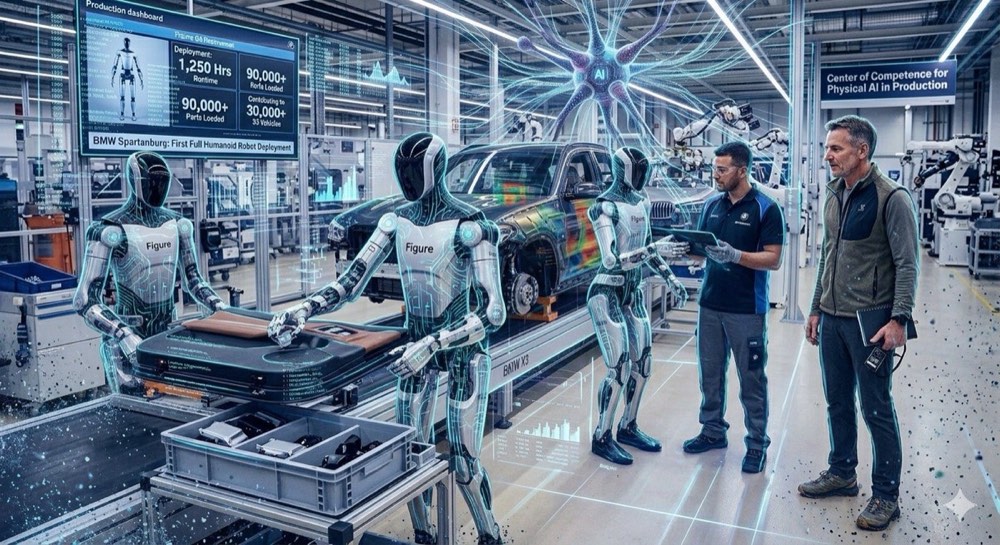
In 2025, BMW completed what is widely considered the first real deployment of humanoid robots inside an active automotive production environment. This wasn't a staged demo. It was operational reality.
Figure AI's humanoid robots worked inside BMW's Spartanburg plant:
- → Running full 10-hour shifts
- → Operating across an 11-month period
- → Handling tens of thousands of components
- → Contributing to real vehicle production
This is the key shift: humanoid robots are no longer being tested. They are being used.
BMW is now expanding deployments into Europe and has established a dedicated "Center of Competence for Physical AI in Production." They're not asking if robots belong in factories. They're figuring out where to deploy them next.
Tesla's Optimus: From Prototype to Production Infrastructure
If BMW proved the concept, Tesla is attempting something much bigger: industrial-scale humanoid manufacturing.
Tesla Is Converting an Existing Factory
In 2026, Tesla began repurposing part of its Fremont factory — historically used for Model S and Model X production — into a dedicated Optimus robot manufacturing line.
Tesla is:
- → Taking real automotive capacity offline
- → Reallocating it to robotics
- → Building robots on actual production lines — not prototypes in labs
That shift alone marks a turning point.
A New Factory Is Already Underway
At Gigafactory Texas, Tesla has broken ground on infrastructure designed specifically for Optimus production at scale.
If Tesla executes, this could scale to hundreds of thousands — potentially millions — of humanoid robots per year. That's not a robotics program. That's a manufacturing revolution.
This Is Now a Competitive Race
Tesla and Figure are not alone. The humanoid robotics space is quickly becoming one of the most competitive sectors in technology.
- → Boston Dynamics — transitioning from research to deployment, integrating AI through partnerships with leading machine learning groups
- → Agility Robotics — already operating in logistics environments, focusing on high-frequency, repeatable tasks
- → Apptronik — working directly with automotive manufacturers to embed humanoids into production systems
- → 1X Technologies — backed by OpenAI, targeting human-safe robots designed for home environments
Different strategies. Same direction. Everyone is moving toward real-world deployment.
The Supply Chain Reality Most People Miss
The limiting factor isn't AI. It's hardware.
Humanoid robots are fundamentally physical systems — and the majority of their cost comes from:
- → Actuators
- → Motors
- → Gear systems
- → Sensors
- → Batteries
Right now, a significant portion of this supply chain is concentrated in China — roughly 70% of key components. And here's the surprising part: AI chips represent only a small fraction of total robot cost. The real bottleneck is movement, dexterity, and power.
Which means the biggest winners may not be software companies. They may be:
- → Advanced manufacturing firms
- → Sensor companies
- → Battery innovators
- → Precision engineering suppliers
The "picks and shovels" of the humanoid economy.
Where You'll See Robots First
The rollout won't happen all at once. It will move through environments where the economics already make sense.
Factories, Warehouses, Logistics
Already underway. Tasks are repetitive, environments are controlled, labor shortages are acute. The ROI is immediate.
Healthcare Logistics
Not replacing clinicians — supporting them. Supply transport, medication delivery, inventory management. Freeing human staff to focus on care.
Elder Care Support
Driven by demographics. Aging populations are creating demand for mobility assistance, monitoring, and daily living support.
The Home
The hardest environment — and the biggest prize. If costs fall into the $20K–$30K range and reliability improves, home deployment becomes viable at scale.
The Real Breakthrough: Physical AI
What's changed isn't just robotics. It's intelligence.
For decades, robots were limited to rigid programming. Now they are being powered by:
- → Vision-language models
- → Reinforcement learning
- → Foundation AI systems
This allows them to understand natural language, adapt to new environments, and learn tasks dynamically.
We are moving from programmed machines → adaptive physical intelligence. That is a fundamental shift.
Why This Changes Everything
The biggest constraint in robotics has always been manufacturing. Not capability — scale. Tesla is attempting to solve that now.
We've seen this pattern before:
Slow start. Sudden inflection. Mass adoption.
Humanoid robots are entering that same curve.
Final Thought
We've officially crossed the threshold.
We are no longer waiting for humanoid robots to arrive.
We are watching the infrastructure being built to produce them.
Factories are being converted. New ones are being constructed. Supply chains are forming.
This is what the beginning looks like.
And once it starts — it doesn't slow down.
// newsletter
Want more like this?
Join the PTL Signal newsletter. Weekly AI, Bitcoin & market analysis from Lisa Tamati.