Jensen Huang at Milken: The Five-Layer Cake, the 1000x Compute Jump, and Why the Doomers Are Missing the Point
Lisa Tamati reporting on Jensen Huang's Milken Institute address and conversation with Becky Quick.
The Five-Layer Cake Gets Concrete
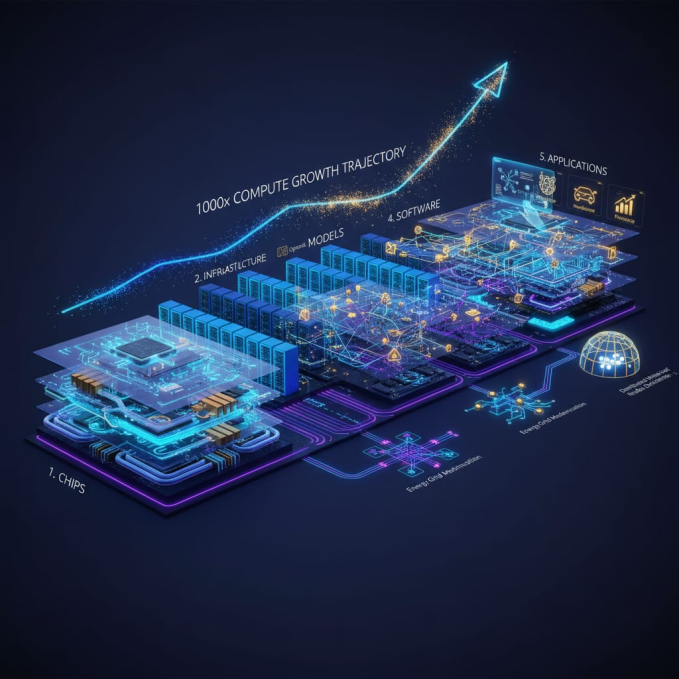
Jensen Huang has been talking about the "five-layer cake" for years: chips, infrastructure, models, software, and applications.
But at Milken, he got specific about where the bottlenecks actually are — and where Nvidia is already investing to clear them.
The five layers aren't theoretical. They're real infrastructure problems.
Layer 1: Chips. Not just GPUs anymore. Nvidia's systems now have seven different types of silicon. The Vera Rubin data center rack is twice the width of a stage. It weighs three tons. It has 1.5 million parts inside. Silicon photonics. Advanced 3D memory. Liquid cooling. Extreme electronics.
Layer 2: Infrastructure. The data center is a football field of these racks. Each one costs $4–5 million. Coreweave, Crusoe, NScale — Nvidia is anchoring investments in companies building the physical compute infrastructure that the cloud can't build fast enough.
Layer 3: Models. OpenAI and Anthropic have turned the corner on gross margins. Both companies are racing for capacity because their tokens are now extremely profitable. This is the tipping point: AI went from money-losing R&D to profitable business.
Layer 4: Software. Agents. Tool use. Agentic AI systems that can reason, plan, and execute across multiple platforms.
Layer 5: Applications. Healthcare, transportation, finance, retail. Every industry getting revolutionized.
The key insight: Nvidia invests where $1 of capital unlocks $100 of AI value. That's how you think about bottleneck-clearing. Not "what's cool," but "what's choking the system."
The 1000x Compute Demand Moment
Two years ago, the bottleneck was chips. You couldn't make GPUs fast enough.
Today, the bottleneck is compute density. And it's growing exponentially.
"In two years, the number of cars you need in the world grew by a thousand times," Huang said. "In two years, the number of airplanes you need in the world grew by 2,000 times."
Translation: Agentic AI requires 1,000x more computation than generative AI.
Generative AI (ChatGPT) lets you write a story. You input a prompt, it generates tokens.
Agentic AI has to understand your intent, reason through a solution, plan the steps, use tools (browsers, spreadsheets, Photoshop), generate output, iterate.
That's not 10x more compute. It's 1,000x more compute.
"GPU consumption is going through the roof," Huang explained. "Even GPUs we sold four or five years ago are now rising in price faster than good wine. Buying Nvidia GPU is like investing in art."
And that's the secular trend: compute consumption exploding because agentic workflows are exponentially more powerful than generative ones.
Why You Should Be Optimistic (And Why the Doomers Are Wrong)
This is where Huang got direct about the fear-mongering.
The concern: AI will eliminate jobs. The doomers — Geoffrey Hinton and others — claiming 20–30% chance of human extinction.
Huang's response: It's not that simple.
First, the job displacement myth.
A computer scientist famously predicted radiologists would be wiped out because AI is superhuman at reading scans. Twenty years later? Radiologists are more in demand than ever.
Why? Because they could now study more scans. They could take more patients. They could diagnose disease better. Hospitals wanted to hire more radiologists, not fewer.
The mistake: confusing the task (reading a scan) with the job (diagnosing disease and treating patients). AI automates tasks. Jobs evolve.
"Your purpose in life is not to sit in a dark room and look at a workstation," Huang said. "Your purpose in life is to work with doctors, help treat patients, diagnose disease. Studying a scan is just a task you do."
Second, the current labor market.
AI is creating jobs faster than it's displacing them.
- $100 billion invested in AI startups last year — the largest investment in human history. All of that went to jobs.
- Software engineering jobs are rising, not declining. While coding is now AI's specialty, companies are hiring more software engineers, not fewer.
- Data center construction. Chip plants. AI factories. Three trillion dollars of re-industrialization opportunity.
"The first thing that AI is doing right now is creating an enormous number of jobs," Huang said. "AI is the United States's best opportunity to re-industrialize ourselves."
The Real Risk: We Scare People Away
Huang's biggest concern? Not that another country gets AI. Not that AI becomes sentient.
That Americans get so scared of AI they disengage from it.
"The worst outcome for AI for our nation is not that another country gets AI. Everybody should have AI. The global south should have AI. Every company, every country should have AI. It empowers them. It lifts them. It elevates them."
His fear: "We scare United States people to the point where AI is so unpopular that we lose our lead as a nation."
The U.S. didn't invent the industrial revolution. But we applied it better than anyone else. That's why we became a superpower. If Americans are too scared to use AI, we'll lose that advantage.
The Pragmatist vs. The Doomers
Geoffrey Hinton said there's a 20–30% chance AI ends human existence.
Huang's response: "He's completely wrong that a whole bunch of smart people aren't working to prevent that from happening."
There are 10 people working on AI safety for every one person trying to make AI smarter.
Cars are safer because of redundant systems and diverse sensors. Planes are safer the same way. AI will be too.
"It's our responsibility as the industry to make AI safe," Huang said. "And the reason for that is because only we know how to do that."
The guardrail systems today are incredible. Every time someone finds a way to misuse an AI model, companies fix it. This is how you get to safe systems: deployment + feedback loops + rapid iteration.
The Agentic AI Moment Is Now
Here's what actually happened in the last 6 months:
OpenAI and Anthropic launched agentic systems. Claude agents. Models that can use tools.
And suddenly, AI became useful for actual work.
"The moment that AI became agentic, the moment it could understand, reason, plan, use tools to do something useful, suddenly AI became actually useful," Huang said.
Software coding was the first big win. That's a task that unlocks other tasks.
But coding is just the beginning. Every company wants to automate something. The fact that AI can now reason through problems and execute multi-step workflows changes everything.
This is the shift from "AI generates content" to "AI executes work."
The Energy Question & Re-industrialization
If compute demand is growing 1000x, where does all that energy come from?
Huang sees this as opportunity, not just burden.
"AI is the world's best opportunity to modernize the power grid," he said. "The United States power grid is a little antiquated. We now have an opportunity to use market forces to invest in sustainable energy."
If nuclear, wind, solar, or whatever sustainable energy you choose — there are suddenly abundant customers willing to pay.
Huang mentioned the CHIPS Act: "I told the administration, 'I'm going to give half a trillion dollars of orders to suppliers. I bet they come to United States.' Boom. They all came."
That's market forces driving re-industrialization. Hundreds of thousands of jobs created in chip plants, data centers, and AI factories.
Open Source Is the Cyber Defense
Huang addressed the weaponized AI concern head-on.
Mythos (high-capability coding model) could theoretically be used by bad actors to find security vulnerabilities.
The defense? Not another Mythos. Not banning Mythos.
Open source.
"The way you defend against a super force is not with another super force. It's with an abundance of cheap force," Huang said. "Open source swarms of white blood cells, trained to detect and alert us of threats."
The more white hats have access to powerful tools, the faster they can detect and patch vulnerabilities. You can't out-Mythos the hackers. But you can out-number them.
The 100x Ambition Reset
Huang ended on something unexpected.
He's rethinking how ambitious he should be.
"Every day I wake up talking to professors and scientists. And what used to take months for researchers to explore, they can now use AI to do in a day. What used to be months is now a day."
Open science. Drug discovery. Climate science. Energy science. Biology.
The breakthroughs are accelerating.
"Whatever level of ambition I had, I realized it's just not high enough," Huang said. "Whatever expectations I have, I've got a 100x in my head now."
If someone tells him they can do something, his response: "Multiply that by 100."
That's the real inflection point. Not AI replacing humans. Not humanity ending. Humans realizing what they can actually accomplish with AI as a thinking partner.
What This Means
The debate is framed as optimists vs. pessimists. Boomers vs. doomers.
Huang is neither. He's pragmatic.
Pragmatism says: AI is a tool. Like electricity. Like the internet. Like the industrial revolution. It disrupts, it dislocates, it creates new opportunities. Some jobs disappear. More emerge. Your job title might stay the same, but your tasks evolve.
The real risk isn't AI. It's that we scare ourselves away from learning how to use it.
The real opportunity is every industry getting re-architected around intelligence. Every country, every company, every person with access to AI becomes more productive.
That productivity creates wealth. Wealth creates opportunity. Opportunity creates ambition.
The question isn't whether AI will change the world. The question is whether you'll be leading that change, or following it.
Lisa Tamati is a professional ultra-endurance athlete, author, and host of the Pushing the Limits Podcast. She runs a longevity health practice and supplement company from Taranaki, New Zealand.
// newsletter
Want more like this?
Join the PTL Signal newsletter. Weekly AI, Bitcoin & market analysis from Lisa Tamati.