Jordi Visser's Capex Arbitrage: Short the Hyperscalers, Long the Infrastructure Into Q2 Earnings
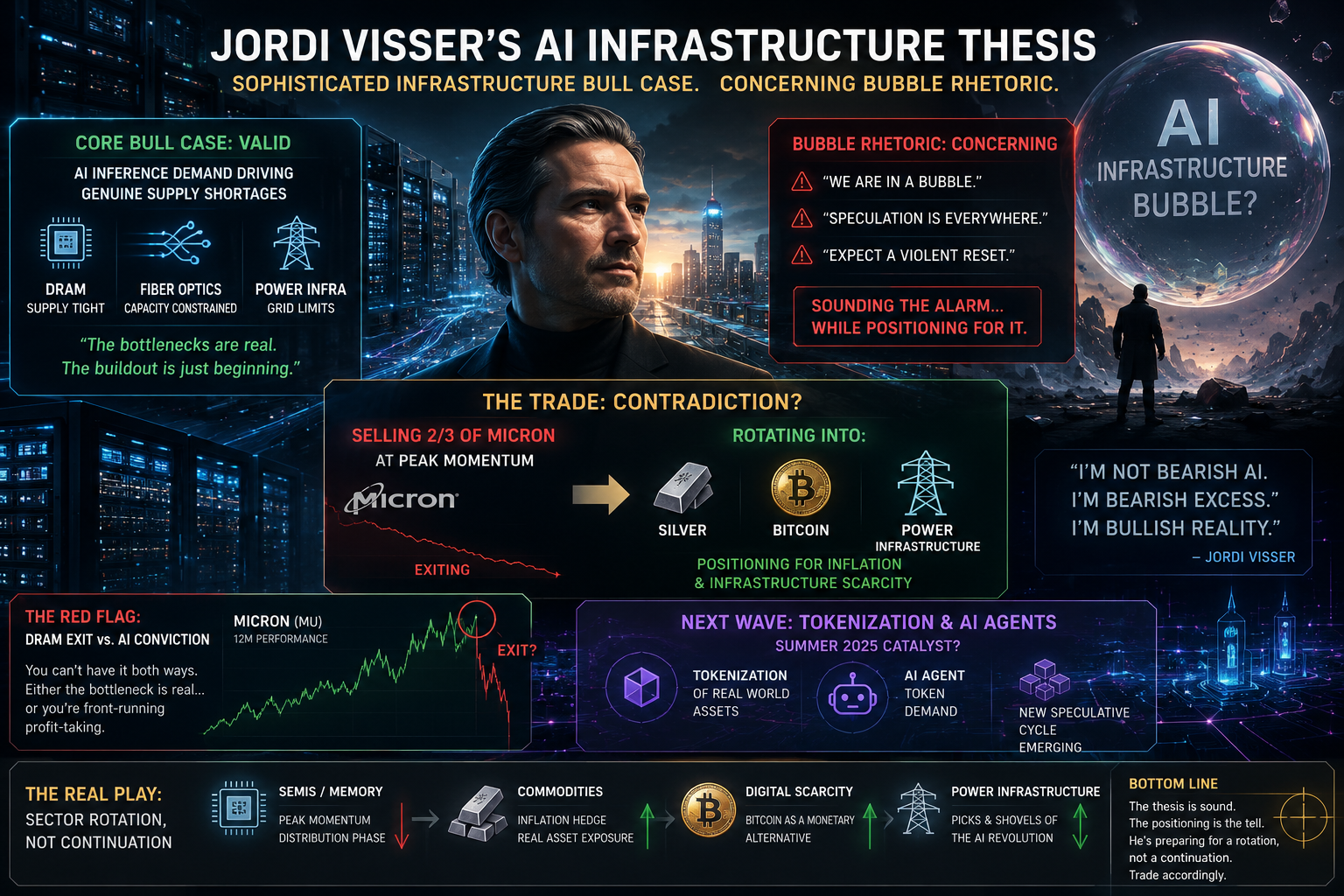
Lisa Tamati reporting on Jordi Visser's latest macro thesis — and why it's his highest-conviction setup heading into Q2 earnings.
The Trade in One Line
Visser's positioning right now is unusually clean:
- Long the AI infrastructure layer — semiconductors, memory, power, cooling, optical, the neo-clouds.
- Short the hyperscalers — Microsoft, Meta, Alphabet.
He calls it capex arbitrage, and he doesn't bury the lede:
"Your capex is my opportunity. That is the focal point."
The logic: the hyperscalers are committing hundreds of billions to build AI capacity. The infrastructure companies sell them the equipment to do it — and collect the revenue whether or not the hyperscalers ever earn an adequate return on the spend. Visser's bet is that the return math is starting to break, and that the market hasn't repriced the two sides of that trade yet.
Who Jordi Visser Is (And Why You Should Listen)
Visser is a macro and markets strategist who has become one of the most accurate readers of AI infrastructure trends over the past 18 months. He got the structural scarcity story right early — the bottleneck in chips, memory, and power — and he called the rotation out of semiconductors and into power infrastructure before consensus caught on.
His edge is reading regime shifts ahead of the crowd: commodity supercycles, inflation reversals, correlation breakdowns. He pairs rigorous technical chart reading with first-principles thinking about how AI economics actually work — not how the narrative says they work.
And the capex-arbitrage call is his latest, and possibly his most important, yet.
The Catalyst: Open Source Caught the Frontier
The piece that makes this urgent is that open-source models have reached frontier quality at a fraction of the cost.
"GLM 5.2 beats GPT 5.5 on multiple long horizon coding benchmarks for one-sixth the cost."
"They caught up. GLM 5.2 is as good as Opus 4.8. That is an insane statement."
The consequence is structural: token pricing power for the frontier labs compresses, because an open-weight model at a sixth of the cost sets the ceiling on what anyone can charge. Visser points to Microsoft reportedly exploring DeepSeek for Copilot as the tell — when even the incumbents shop the cheaper option, pricing discipline is gone. The companies that spent the most building the infrastructure are now staring at commoditising model quality, collapsing token pricing, and an ROI timeline that keeps getting fuzzier.
Meanwhile, the companies selling them the hardware get paid regardless. Semis get paid whether the model wins or loses. Power gets paid either way. Cooling gets paid either way. That asymmetry is the whole trade.
The Hyperscaler Squeeze: Free Cash Flow and the Depreciation Time Bomb
The bear case isn't just pricing. It's the income statement.
Capex is surging while free cash flow deteriorates, and the capex being spent today doesn't hit earnings today — it lands later, as depreciation, once the GPUs are racked and running. That lag is the mechanism:
"The AI spending movements creating a depreciation time bomb."
Spend now, depreciate over the next few years, and the revenue that's supposed to justify it has to show up on schedule. The closest historical rhyme is the telecom fibre build of 1999 to 2001 — aggressive capex into an uncertain demand curve, multiples compressing two to three years before revenue inflected. That's the pattern Visser sees setting up here.
The Tail Risk: Recursive Self-Improvement
The bigger risk to the entire data-center capex cycle is that algorithmic efficiency decouples from hardware spend.
"These models are improving without the benefits of all the money being spent on capex right now."
If models start improving themselves with less incremental compute rather than more, the demand curve the whole buildout is priced on gets revised down. Visser's framing:
"The market may eventually wonder whether the capex curve has been overestimated."
This is the question he expects to surface on Q2 earnings calls. If management commentary softens on forward capex, the derating could be fast.
Meta and Google: Execution Risk
Two of the three shorts have a company-specific problem on top of the macro one.
Meta: a roughly $15 billion AI hiring push that, by Visser's account, has yet to produce a competitive frontier model, with Llama leadership gone and morale reportedly near lows. The detail he can't resist: the company is "increasing snack budgets" — the corporate tell that you're managing symptoms, not the cause.
Google: Gemini has slipped on quality and cadence versus the leaders, and got caught flat-footed by the open-source wave. Of the three, Visser sees Google as the most structurally exposed because the model gap is hardest to close quietly.
Both are spending heavily, falling behind, and walking into Q2 prints where the capex justification gets scrutinised.
Microsoft's Chart Is the Tell
Visser's most pointed call is on Microsoft, and it's technical.
"MSFT is gruesome. Unchanged since ChatGPT launch. Failing at 200-week MA repeatedly."
The most-watched name in the AI trade, supposedly the cleanest infrastructure proxy, has gone roughly nowhere since the AI boom began and keeps getting rejected at its 200-week moving average. For a stock that's meant to be the AI winner, that's a divergence worth respecting — price is voting against the narrative.
The Macro Backdrop: The Fed Is Boxed In
The rate picture supports the trade, and the disinflation case is strong.
One-year inflation swaps just posted their largest drop since the 2022 peak, and the Cleveland Fed is forecasting roughly 0% month-over-month June CPI, which would pull year-over-year down toward 4%. With the policy rate sitting materially above the pre-COVID neutral level and the momentum clearly down, the case for another hike has evaporated.
That boxes the Fed in — no justification to tighten further, and a clear path toward easier policy as the data cooperates. For equities, that's a tailwind: lower real rates, a hawkish surprise off the table, and a setup where small caps and thematic infrastructure are positioned to lead.
Small Caps and the PEG Story
The part of the setup that's pure fundamentals, not narrative, is the valuation math.
"The S&P's earnings are up 28% year-over-year. The S&P is not up 28% year-over-year."
Earnings have outgrown price, which means multiple compression is happening underneath a market that looks expensive on the surface. The S&P's PEG ratio is at its lowest in roughly 22 years. Small caps tell the same story — the Russell 2000 making new highs with PEG ratios collapsing, an earnings-driven move, not a speculative one. Visser's point lands: passive, mega-cap-heavy portfolios are structurally on the wrong side of where the earnings growth is actually flowing.
The Names: Where the Capex Lands
The way Visser plays it splits cleanly into the names absorbing the capex and the names spending it.
Micron is the clearest example of the long side, and the tape has already validated it. As of this week MU is trading around US$1,130 — a market cap near US$1.28 trillion, up more than 800% over the past year. A memory company reaching that scale was unthinkable not long ago, and it is exactly the trajectory the infrastructure-scarcity thesis pointed to. Alongside it sit power (the genuine final bottleneck), optical (GPU interconnect), cooling, and selective neo-clouds like CoreWeave and IREN — the names that absorb the buildout so others don't have to.
On the short side, the structures discussed are defined-risk by design. A bear put spread on Microsoft into Q2 caps the premium at risk while the thesis plays out. For leveraged upside on the long side, a call ratio backspread — selling a nearer call to fund two further-out calls — gives explosive participation on a continuation move without much premium outlay.
One framing note: this is a pair trade. The long infrastructure leg and the short hyperscaler leg are designed to offset — the alpha is in the spread between them, not in either side alone. And anchor any structure to the current tape: the strike levels circulating from earlier this year are well out of date (Micron alone has multiplied severalfold), so size and strike off where these names are trading today, not off stale figures.
The Bottom Line
Visser is calling the next rotation before consensus: long the infrastructure that gets paid regardless, short the hyperscalers whose return math is starting to wobble. The hyperscalers are already underperforming the S&P by 8 to 9% this month, and Q2 earnings are the catalyst that exposes the divergence.
When the market realises hyperscaler capex ROI is uncertain and open-source has commoditised the frontier, the repricing will be swift — and the names positioned ahead of that realisation are the ones that capture it.
Important Disclaimer
This is analysis of an investor's stated positions and thesis, not financial advice. All trade ideas discussed are hypothetical and educational. Past performance does not guarantee future results. Verify claims from original sources before making decisions. Consult a licensed financial advisor.
Lisa Tamati is a professional ultra-endurance athlete, author, and host of the Pushing the Limits Podcast. She runs a longevity health practice and supplement company from Taranaki, New Zealand.
// newsletter
Want more like this?
Join the PTL Signal newsletter. Weekly AI, Bitcoin & market analysis from Lisa Tamati.