Jordi Visser on DRAM Bubble Peak: The Real Supply Shock, the Sector Rotation, and Why He's Selling Micron
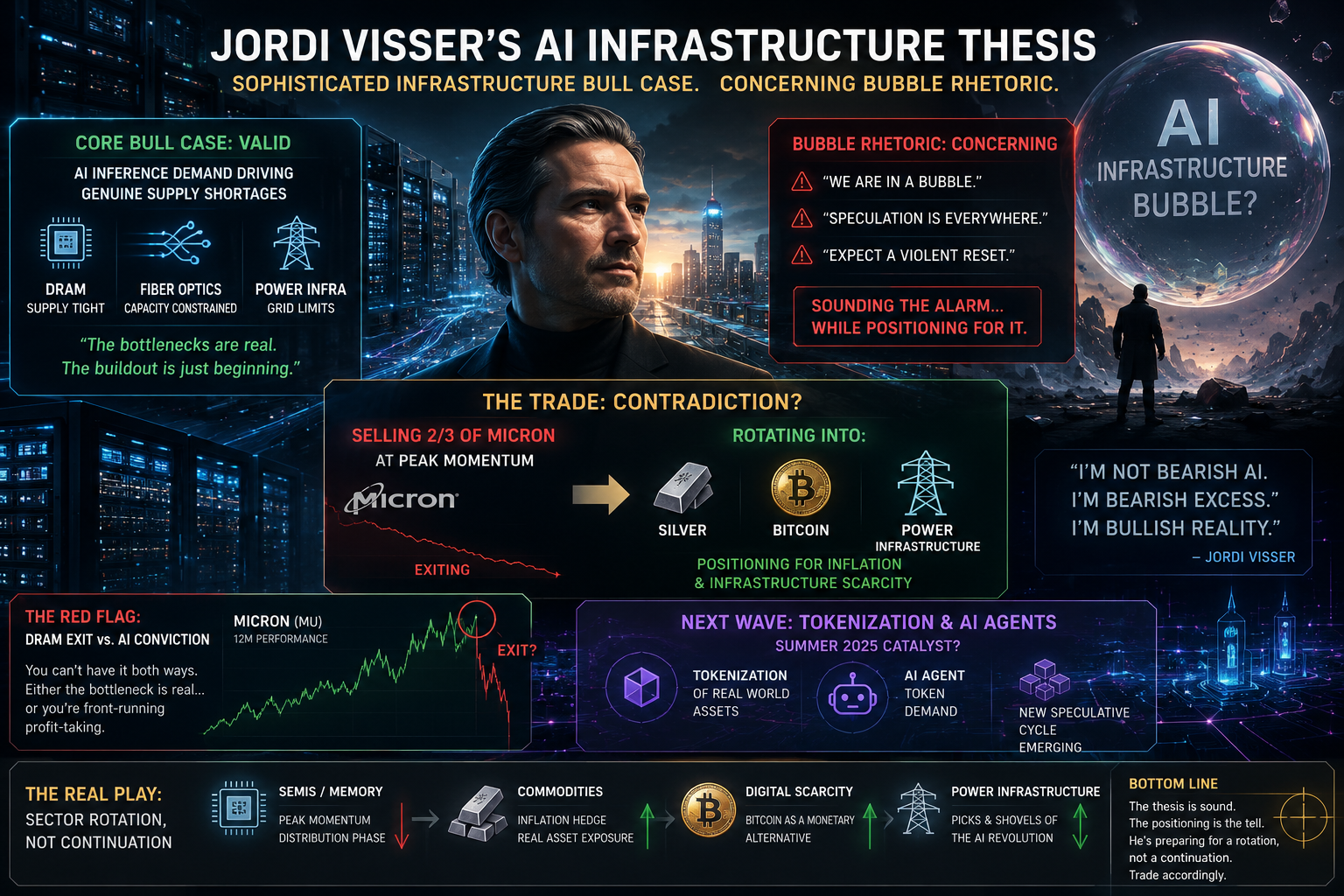
Lisa Tamati reporting on Jordi Visser's infrastructure analysis.
The Contradiction That Reveals Peak Euphoria
Here's what matters most in Jordi Visser's analysis, and it's hiding in plain sight.
He's bullish on AI infrastructure long-term. The supply constraints are real. The shortage dynamics are structural, not cyclical. Anthropic growing 80x while DRAM supply grows 10x? That's a genuine bottleneck.
But he just sold 2/3 of his Micron position.
While maintaining his AI thesis.
That's not bullish. That's a sector rotation signal disguised as tactical profit-taking.
The AI Infrastructure Bottleneck Is Real (But Priced for Perfection)
Visser distinguishes between hype and reality — and this is important.
The infrastructure constraint isn't bubble fiction. It's structural:
"DRAM prices went through the roof. Demand is ahead of supply right now and that's the big story."
Anthropic's 80x business growth versus 10x planning reveals the supply/demand mismatch. This isn't speculation. It's real physical scarcity of chips, fiber optics, cooling equipment, power distribution.
The parabolic moves in Corning, DRAM producers, and power infrastructure reflect genuine bottlenecks.
But here's where Visser gets sophisticated: Real infrastructure constraints don't mean indefinite parabolic stock moves.
They mean the moves are real until they're not.
And when the architect of the thesis is exiting 2/3 of his position, you're seeing peak euphoria timing — not the beginning of the cycle.
The Sector Rotation: Semis to Power
This is the actionable signal.
Visser is rotating from components (semiconductors) to enablers (power infrastructure).
"If that's the case, I don't want to be in semis as much as I want to be in power."
Translation: Semiconductors have priced in current demand. Power infrastructure hasn't.
Why does this matter? Data center buildout requires both. Semis get the headlines. Power infrastructure is the constraint nobody's talking about yet.
When he sold 2/3 of Micron — peak euphoria semiconductor — while rotating into silver, power stocks, and Bitcoin, he's signaling: "Semiconductor prices have reached their highs. Next leg is power infrastructure solving the constraint."
Classic late-cycle rotation from the hottest sector to the one about to become the limiting factor.
Tokenization: The Next Speculative Frontier
This is where the thesis gets forward-looking.
Visser identifies AI agents as the next demand wave:
"AI agents are with us. They need food and that food is not physical food. It is tokens."
If AI agents require tokens to operate — as payment mechanisms, resource allocation, autonomous transaction execution — then crypto isn't speculation anymore. It's infrastructure.
"I think tokenization reality is going to start to set in in the summertime."
This suggests specific catalysts around July 2025: regulatory clarity, technical implementations, institutional frameworks.
If true, this creates a new demand vector for crypto beyond store-of-value narratives. Institutions don't buy Bitcoin as digital gold. They buy it if it's operational infrastructure.
The Divergence: Retail Euphoria vs Institutional Sidelined
Here's the vulnerability in Visser's bull case.
Retail is driving parabolic moves in DRAM ETFs that grew from zero to $5B in weeks. Institutions are stepping back.
This creates two scenarios:
Scenario 1 (Bearish): Institutions are right to wait. Retail capitulates. DRAM and semis correct 30–50%.
Scenario 2 (Bullish): Institutions are being too cautious. When they finally capitulate and FOMO in, the moves continue higher.
Visser's position — exiting semis while maintaining conviction in the infrastructure theme — suggests he thinks Scenario 1 is more likely near-term, with Scenario 2 returning later (tokenization summer, power infrastructure next).
What This Means: Timing Over Thesis
Jordi Visser's core thesis is sound.
AI infrastructure bottlenecks are real. Supply/demand mismatches are structural. New demand vectors — agents, tokens, power — are emerging.
But his trading behavior contradicts a simple "hold and ride the wave" narrative.
Selling 2/3 of Micron while bullish on AI says: "The thesis is right. The timing is peak."
This is sophisticated late-cycle positioning:
- Exit the momentum play — semis at euphoria
- Rotate to the next constraint — power infrastructure
- Position for the next wave — tokenization, AI agents
The risk: If institutions step in and fuel continued semi rallies, this rotation looks premature. The reward: If retail momentum breaks and institutions stay sidelined, he's exiting near the top.
Trade Structure (Hypothetical)
- Short MU (Micron): Put spread structure ($100/$90) to profit from DRAM pullback with defined risk.
- Long XLE (Energy): Power infrastructure rotation play; institutions eventually have to fund this buildout.
- Long SLV or Bitcoin: Either as inflation hedge or as tokenization upside.
- Avoid: Pure DRAM ETF positions at current euphoria levels. Wait for institutional buyers or better entry points.
The Bottom Line
Visser sees the infrastructure constraints. He's not denying them. But he's executing a classic late-cycle rotation: exit the peak momentum, rotate to the next bottleneck, position for the next speculative wave.
This is how sophisticated investors navigate bubbles — not by calling them crashes, but by rotating within them before the exit signal becomes obvious to retail.
This is analysis of an investor's stated positions and thesis, not financial advice. All trade ideas presented are hypothetical and educational. Past performance does not guarantee future results. Verify claims from original sources before making decisions. Consult a licensed financial advisor.
Lisa Tamati is a professional ultra-endurance athlete, author, and host of the Pushing the Limits Podcast. She runs a longevity health practice and supplement company from Taranaki, New Zealand.
// newsletter
Want more like this?
Join the PTL Signal newsletter. Weekly AI, Bitcoin & market analysis from Lisa Tamati.