James Mullarney on AI-Crypto Convergence: The Infrastructure Moment the Market Isn't Pricing In
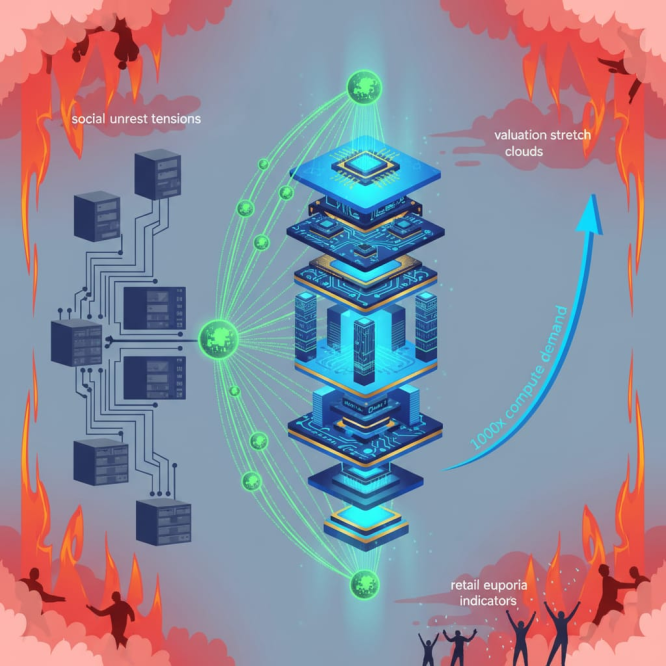
Lisa Tamati reporting on James Mullarney's market analysis. For informational purposes only — not financial advice. All trade ideas are hypothetical. Consult a licensed financial advisor before making investment decisions.
The Core Thesis: AI Needs Blockchain Payment Rails
Here's what most investors are missing.
AI agents don't need humans to approve transactions. They need infrastructure to execute microsecond transactions on behalf of their users without waiting for banking rails.
This creates a fundamental shift: AI agents require blockchain-based payment systems to operate at machine speed.
"Solana is where agents live and transact. It has effectively become the credit card for AI agents," Mullarney explains.
That's not speculation. Google Cloud already integrated pay.sh (built on Solana) into their AI infrastructure, connecting it to Gemini, BigQuery, and Vertex AI.
If this thesis is right, Solana becomes a critical infrastructure layer for AI at scale. Not a crypto speculation. Pure infrastructure play.
The 1000x Compute Problem (We're Not Ready)
Two years ago, the constraint was chips. We couldn't make GPUs fast enough.
Today, the constraint is scaling compute infrastructure for agentic AI.
AMD just doubled their forecast guidance in 12 weeks. The stock was $190 five weeks ago. It's near $450 now. The market is signalling something is broken in supply forecasting.
Why? Agentic AI — reasoning, planning, tool use — requires 1,000x more compute than generative AI (token generation).
"Infinite demand," Mullarney says. "Token usage expected to go up 24x."
Google committed $200 billion for TPU infrastructure in 2026 alone. That's not R&D spend. That's capital expenditure on physical compute infrastructure.
If demand is real — and AMD's 12-week guidance double suggests it is — then chip companies and infrastructure plays are sitting on a multi-year tailwind.
The Musk Ecosystem Play Is Sophisticated
This one is complex.
By providing idle Colossus 1 capacity to Anthropic, Musk does something elegant:
- Generates revenue on spare capacity
- Studies how Anthropic operates their data centres (competitive intelligence)
- Potentially weakens OpenAI by giving Anthropic compute to scale aggressively
- Positions XAI for the SpaceX IPO as a credible AI infrastructure player
The upcoming SpaceX IPO at $2 trillion valuation would be the largest public offering in history. It would fundamentally reshape market cap rankings.
"SpaceX AI are pushing for trillion watts of compute power from these terra fabs," Mullarney notes. "They give them their old facility to be able to compete… watch this space carefully."
The implication: SpaceX isn't just a rocket company anymore. It's an AI infrastructure play competing with Google and Microsoft for dominance.
Google's Valuation Is Broken (And Everyone Knows It)
This is the key red flag.
Google is trading at 133x free cash flow. Five years ago, it was 20x. That's a 6.6x multiple expansion — while dumping $185 billion into capex.
"Google is trading at all-time high… 133 times free cash flow. When it was 5 years ago was 20. They'll spend $185 billion in capex in 2026."
How do you justify that? Mullarney doesn't claim it's impossible. He claims it requires Google to demonstrate clear ROI on that capex. Without that proof, multiple compression becomes likely.
This creates a specific trade: short Google when capex ROI questions remain unanswered. The catalyst is earnings calls where management has to defend $185B annual capex spending.
The Retail Euphoria Indicator That Scares Him Most
"20 year olds retiring on two or three months in semiconductors when there's people who've been investing for 40 years and got nowhere."
That's a classic bubble signal.
When retail investors with minimal time horizon see life-changing gains in weeks, you're in late-cycle positioning. Mullarney doesn't say crash is imminent. He says: position sizing becomes critical, hedges become necessary, contrarian thinking becomes essential.
The Trade Structure (Hypothetical Analysis Only)
These are hypothetical trade ideas for educational purposes only. Not investment advice.
Long: AMD (Core AI Chip Play)
- Entry zone: $380–400 | Target: $600 | Stop: $340
- Risk/reward: 3.3:1 | Timeframe: 6–12 months
- Rationale: 12-week guidance double, infinite demand thesis
Pair Trade: Long NVDA / Short GOOGL
- NVDA long: $800–850 → $1,200 target (maintains chip leadership)
- GOOGL short: $210–220 → $180 target (multiple compression from 133x FCF)
- Risk/reward: 2.8:1 | Timeframe: 3–6 months
Long: TSLA (SpaceX IPO Catalyst + Robotaxi)
- Entry zone: $380–420 | Target: $650 | Stop: $320
- Risk/reward: 2.3:1 | Timeframe: 12–18 months
Short: COIN (Crypto Exchange Disruption)
- Coinbase is laying off 14% of staff because engineers can ship in days what took months — AI-driven productivity destroying the old model
- Entry zone: $280–300 → $180 target | Timeframe: 6–9 months
Long: MRVL (Marvell / Custom Chip Demand)
- 100% move in the last month — custom chip demand from Google's $200B commitment
- Entry: $110–115 → $180 target | Timeframe: 6–12 months
The Historical Pattern: Winner-Take-Most Dynamics
Mullarney identifies a critical pattern: technology convergence creates concentration.
In the mobile + internet convergence (2007–2012), 90% of value was captured by 3–5 winners.
"99.8% of crypto is dead. Winner takes most."
Translation: most projects die. A handful dominate. This supports infrastructure plays (NVDA, AMD, TSLA, Solana) over speculative tokens.
The Risk Everyone's Ignoring: Social Instability
South Korea is already seeing protests over AI wealth concentration.
"South Korean people… are already taking to the streets and demanding their share of AI profits. Can you imagine what people would do in places like Portland and Seattle?"
This isn't a market risk in the traditional sense. But if political backlash against AI accelerates, policy responses could include export controls on chips, restrictions on AI deployment, massive taxation on AI companies, or mandatory safety regulations that slow adoption.
Hedge: defensive sectors, geographic diversification, avoid concentration in US tech.
The Bottom Line
Mullarney's core thesis: AI infrastructure demand is about to explode, creating 5–10x opportunities in the right companies — but valuations are stretched and retail euphoria is high.
Long: AMD, NVDA, TSLA, MRVL (infrastructure leadership)
Short: GOOGL (valuation compression), COIN (disruption risk)
Hedge: tech puts, defensive rotation, Solana exposure (payment rail infrastructure)
Position sizing becomes critical. Hedges become necessary. The trend is your friend, but the multiple is dangerous.
This is a generational opportunity colliding with bubble-like valuation and retail euphoria. The winners in infrastructure will be enormous. The losers will disappear.
All trade ideas presented are hypothetical and for educational purposes only. Past performance does not guarantee future results. This is not investment advice — consult a licensed financial advisor. Never invest more than you can afford to lose.
Lisa Tamati reports on AI, markets, and technology at PTLsignal.com
// newsletter
Want more like this?
Join the PTL Signal newsletter. Weekly AI, Bitcoin & market analysis from Lisa Tamati.