Mullarney & Biceel: The Convergence of Tesla and SpaceX Is the Biggest Trade of Your Life
Lisa Tamati reporting on the conversation between James Mullarney (Invest Answers) and Phil Biceel. For informational purposes only — not financial advice. All positioning discussed is hypothetical and educational. Consult a licensed financial advisor before making investment decisions.
The Convergence Nobody Sees Coming
Here's what James Mullarney and Phil Biceel want you to understand.
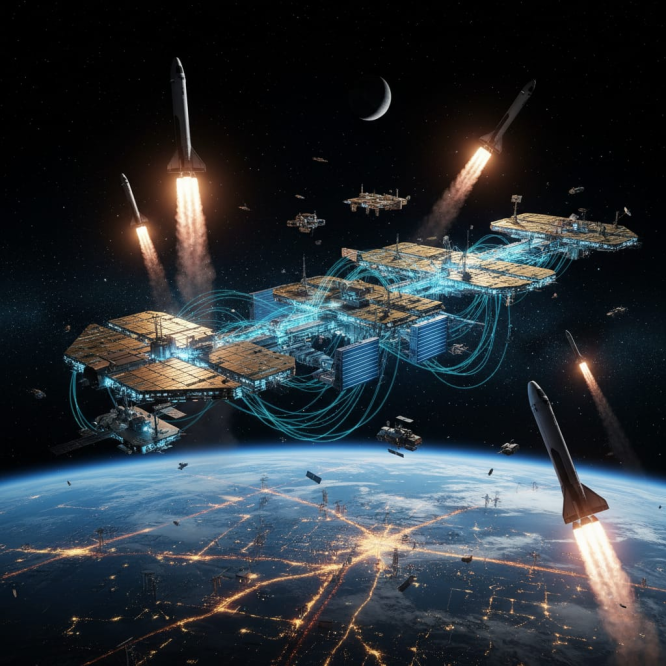
Tesla and SpaceX aren't separate companies competing in different markets. They're converging into a single compute empire that will reshape how civilization accesses intelligence.
And most investors haven't realized it yet.
Phil, a Silicon Valley engineer with tours at Apple and Rivian, sees it clearly: "SpaceX will become a provider of compute to the world through the orbital data center model. If you fast-forward many years and ask where did Anthropic get its compute? Where did Google get its compute? Where did anybody get its compute? It's probably SpaceX and space."
The 1 Terawatt Problem Is Real (And Coming in 4.4 Years)
AI compute demand is growing at 3.5x annually.
At this rate, the world will demand 1 terawatt of compute capacity in 4.4 years. In 10 years, 100 terawatts.
That's not incremental. That's exponential infrastructure buildout on a scale civilization has never attempted.
"This is $90 trillion that's getting washed into hardware things that have been underinvested where bottlenecks and shortages show up in a matter of months."
One terawatt sounds abstract. Think about what it means:
- The entire planet produces 20–30 gigawatts of AI compute today
- One terawatt = 1,000 gigawatts = 33–50x current production
- In 4.4 years
- With only 3 foundries (TSMC, Samsung, Intel) controlling supply
This creates Terrafab. This creates the orbital data center thesis. This creates the SpaceX compute empire.
Terrafab: Not Pie in the Sky — Inevitable
Phil doesn't believe Terrafab is a moonshot. He believes it's inevitable.
"I believe we're reaching for the goal of one terawatt of compute power. Some people would look at that and go, 'That's ridiculous.' And I got news for you — we're getting there."
Here's his reasoning: The demand will hit a brick wall whether Terrafab exists or not. Demand will hit 1 terawatt regardless. If Terrafab doesn't deliver, the supply chain breaks. If it does deliver, Tesla becomes the most leveraged play on the compute layer.
On Elon's approach to chip manufacturing: he'll start with proven processes (Intel's 14N/14A tech stack), build a research center to understand the constraints, then systematically reimagine semiconductor production from first principles.
This is classic Musk: fast-fail iteration combined with deep engineering thinking.
But here's the kicker: one Terrafab won't be enough. Phil calculates the world will need multiple terafabs. And the second one won't look anything like the first.
Why SpaceX Goes to Space (And Why Google Called)
Google was suddenly knocking on SpaceX's door for compute capacity access. That's not random. That's desperation.
Google, Meta, Amazon — all hyperscalers with unlimited capital — can't build data centers fast enough. They can't source chips fast enough. And there's no way to power them all on Earth without infrastructure that doesn't exist.
The only answer: Space.
Phil frames it perfectly: "All paths to space go through SpaceX. At least in the next 5–10 years. SpaceX sits alone and will for many years."
Why? Because Starship is the only platform that can industrialize space at scale. Nobody else is even close.
"Without that platform, you aren't industrializing space. We are at this moment in time where we are starting to look at space differently — not as science projects, but as expansion of industrialization beyond Earth."
Starship: Reusability Is the Secret
The engineering challenge isn't building a rocket. It's making it reusable.
"Reusability is the key issue here. And you know part of it is the reliability that they developed through this Raptor engine."
Phil highlights Starship V3 launching with the Raptor 3 — an extraordinary refinement. And here's why Elon launches on schedule despite the IPO risk:
"His lens is: I'm in a race of time. Yes, even a month matters."
This isn't recklessness. It's a different calculation: the velocity of achieving goals matters more than the risk of a single launch setback. Every month counts. Every iteration counts. Velocity compounds.
The 18 Lines of Business Within Tesla Alone
James mentions analysts identifying 18 different business lines inside Tesla:
- Energy (Powerwalls, grid storage)
- Vehicles (cars, semis, CyberCab, Roadster)
- FSD/autonomy
- Optimus humanoid robots
- Charging infrastructure
- Manufacturing innovation
Phil adds: the synergy is the story. Same vision technology that powers FSD powers Optimus. Same manufacturing innovation that builds CyberCab applies to Optimus. Same power infrastructure serves data centers and robots.
This isn't accidental. This is vertical integration at scale.
Optimus: The $30 Trillion TAM
Phil is clear on the opportunity: "The Optimus TAM is the biggest on the planet right now. Easy. $30 trillion. There is no bigger TAM on Earth."
He sees 2027 as the special year when volume production ramps meaningfully.
But here's what people miss about Optimus vs. competitors: "Once that skill is trained, it can be replicated across the fleet instantaneously. You can't do that with humans."
Teach Optimus to fold laundry. That skill propagates to millions of units overnight. Train a human? 15–20 years from birth to competence. This is the replication advantage nobody's pricing in.
On why Tesla will own the market: "Tesla will largely own the humanoid robot market. The brain, the hands, and manufacturing at scale. Those are the three things that only Tesla can do."
CyberCab: The Prove-It Works Year
2026 will be the year Tesla proves robo taxi operational viability. Not scale — prove.
FSD itself is solved. Phil drives it every day and calls it: "Not a science project. It is how I want to operate my vehicle."
The bottleneck isn't technology. It's operational logistics — call centers, customer support, ride matching at scale. But they're working through it. And 2027 will be "completely off the hook."
The Tesla/SpaceX Allocation Decision
James presents the key question: how much of your capital allocation goes to the converged Tesla/SpaceX thesis?
Phil's position:
Tesla now (next 5 years): Largest TAMs are robo taxi, Optimus, energy, FSD.
SpaceX later (post-2030): Largest TAMs are space industrialization and orbital compute.
Positioning: heavy Tesla now, layer into SpaceX gradually, don't lock up capital in 5-year windows with fees, wait for IPO liquidity.
SpaceX at $2 trillion could 5x in 5–10 years if the orbital compute thesis plays out. Tesla is the call option on SpaceX anyway — same power infrastructure, same chip constraints, same synergy.
What This Means
The narrative everyone's following is wrong.
It's not "Tesla vs. legacy automakers" or "SpaceX vs. Blue Origin."
It's the Musk compute infrastructure empire vs. everyone else fighting over scraps.
Terrafab. Orbital data centers. Terrestrial manufacturing. All feeding a unified vision of computing abundance.
Tesla 2026–2027: Prove robotaxi and Optimus work. Print money from FSD and high-margin vehicles.
SpaceX IPO 2025–2026: Capital raise for space buildout. Starts orbital compute deployments.
Post-2027: Convergence accelerates. SpaceX supplies compute. Tesla uses compute to power Optimus and robo taxi fleet. Energy interconnects everything.
The $30 trillion Optimus TAM plus the orbital data center opportunity equals the trade of the decade. And most investors still think it's separate companies.
This is analysis of investor theses presented in a podcast conversation — not financial advice. All positioning discussed is hypothetical and educational. Terrafab, orbital compute, and mass Optimus deployment remain development projects. Valuations can change dramatically; past performance doesn't guarantee future results. Consult a licensed financial advisor before making investment decisions. Listen to the full conversation for complete context.
Lisa Tamati reports on AI, infrastructure, and markets at PTLsignal.com
// newsletter
Want more like this?
Join the PTL Signal newsletter. Weekly AI, Bitcoin & market analysis from Lisa Tamati.