The Fork in Humanity: Institutional Collapse, Decentralization & the Mindset That Determines Your Future
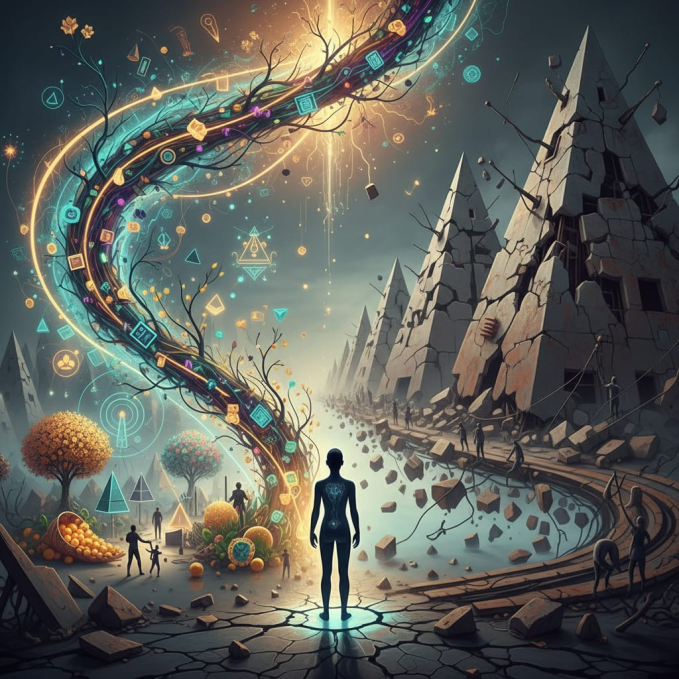
Reporting on Raoul Pal, Peter Diamandis & Salim Ismail on the Global Macro Investor podcast — institutional breakdown, decentralization, and the mindset divide that will define the next decade.
Raoul Pal brought together two of the world's leading exponential technology thinkers — Peter Diamandis and Salim Ismail — for a conversation that doesn't shy away from the uncomfortable truth: our institutions are breaking.
Not failing. Not struggling. Breaking.
"All the mechanisms, both our organizations from a private sector perspective but also our institutions, are breaking in front of the face of all of this technology," Salim stated flatly.
This isn't pessimism. It's observation. And what makes this conversation essential is that it doesn't end with the diagnosis — it charts a path forward. The conversation ranges from why decentralization is inevitable to how humanity will fork into multiple distinct paths based on technology adoption choices. It's about mindset, entrepreneurship, institutional redesign, and what it means to be human when machines can do almost everything.
The Core Insight: Institutions Are Incompatible With Exponential Change
The problem is structural, not cyclical.
Our institutions — corporations, governments, educational systems, healthcare — were designed for linear change. They operate on quarterly earnings calls, annual budgets, five-year plans. They assume stability.
But we're not in a stable world anymore.
Exponential technologies — AI, robotics, quantum computing, biotechnology — are advancing at rates that outpace institutional adaptation. The mismatch is fundamental.
Consider Coase's Law, Salim points out. For decades, it was economically rational to organize work inside large companies because external transaction costs were too high. But that's inverting. Now, transaction costs inside companies often exceed external costs. You can hire a freelancer, use APIs, build distributed teams, and coordinate through networks more efficiently than you can manage internal hierarchies.
"You can't reach abundance with a centralized architecture," Salim argues. "You can't reach the full potential of abundance."
This has profound implications. If centralized institutions are the constraint, then decentralization isn't a political choice — it's an economic necessity.
The Organizational Singularity: Multiple Inflection Points Converging at Once
Peter Diamandis frames the situation differently but with the same conclusion: we're approaching multiple singularities simultaneously.
Not just AI. Not just robotics. Not just fusion energy. But all of them, converging, at the same time. When prediction becomes impossible. When systems exceed human comprehension. When the rate of change breaks our adaptive capacity.
This is new.
Every institution designed around 20th-century assumptions will face a choice: decentralize and reinvent, or fail.
"Organizations will run with 25% of current staff but be 5x bigger," Salim suggests. Not through ruthless layoffs, but through amplification of human capability via exponential technologies. Fewer people, coordinated through networks and AI, achieving more output.
This requires organizational redesign at a fundamental level. It's not about "going agile" or "embracing innovation." It's about reimagining the basic architecture of how humans coordinate.
The Mindset That Determines Your Future
Here's where the conversation shifts from doom to agency.
Peter articulates the critical insight: mindset is the single most important variable.
"The single most important element you need is a mindset of curiosity and agility and adaptability. You have to believe this technology is not happening to you but happening for you."
This distinction is everything.
Are you a victim of technological change, or a creator within it? Do you see AI as a threat or as a tool amplifying your potential?
Peter referenced evolutionary biology: when the dinosaurs faced the asteroid, they couldn't adapt. But mammals — smaller, more adaptable, more curious — survived and eventually thrived. The same dynamic is unfolding now. Not physically, but cognitively and organizationally.
The Forking of Humanity: Disruptor or Disrupted
Salim spoke plainly: "We will fork humanity. I believe we're already there. You're either the disruptor or you're disrupted. There's no middle ground now."
This is perhaps the most provocative claim — and it deserves serious consideration.
The fork isn't biological. It's economic, psychological, and technological.
On one side: Creators, builders, people embracing exponential technology as a tool for amplification. Entrepreneurs, makers, people shifting from consumer to creator mindset.
On the other side: Passive consumers, people for whom technology is something that happens to them. They retain jobs until those jobs are automated. They consume content created by others. They watch rather than build.
There's also a longevity fork — people investing in lifespan extension technologies will access capabilities unavailable to others. And a neurotechnological fork — people with brain-computer interfaces will have cognitive advantages that compound over time.
"There's no neutral anymore," Salim suggests. You're choosing, whether consciously or through inaction.
From Employment to Entrepreneurship
This leads to a radical economic implication: the career of the future is entrepreneurship, not employment.
Peter states it directly: "The career of the future is not getting a job. I think the only career of the future is entrepreneurship."
This doesn't mean everyone needs to start a billion-dollar company. It means everyone needs to think like a creator. Build something. Offer value. Think like an owner, not an employee.
Why? Because:
- AI is automating jobs faster than new jobs are being created in many sectors
- Entrepreneurs with AI tools can outperform employees in bureaucratic organizations
- The barrier to starting something is collapsing — AI gives you instant access to writing, coding, design, and analysis that once required a full team
You don't need permission. You don't need a corporation. You need curiosity, execution, and comfort with rapid iteration.
Raoul pointed out the core irony: "When intelligence is free at the end of the day, what are you actually selling?"
The answer: your taste, your judgment, your vision, your connection to human needs. Things machines can't replicate.
Human Experience Becomes the Primary Value
As AI handles "doing," humans shift toward "being."
"AI and robots take over more and more of the doing," Peter notes. "Human beings can spend much more time being."
Raoul observed: "The more we go digital and the more we go virtualized, the more people crave actual human experience."
Think about what commands premium prices today:
- In-person conferences, not webinars
- Handwritten notes, not emails
- Face-to-face coaching, not courses
- Live music, not recordings
- Authentic relationships, not social media connections
As the digital world becomes ubiquitous and AI becomes invisible, human experience — authentic, present, creative connection — becomes the rarest and most valuable thing.
This reframes the future positively. It's not humans being made obsolete. It's humans being liberated from drudgery to do what we're actually built for: creating meaning, connecting deeply, building community.
Decentralization as Inevitability
Salim went further on the political implications: "Future governance will be city-states rather than nation-states."
This isn't a prediction of collapse. It's recognizing that as technology enables coordination across distance, the optimal scale of governance shrinks. A city-state can make decisions faster, respond to local needs more directly, experiment more freely than a nation-state.
We're already seeing this — city-level innovation outpacing national policy. Crypto and decentralized networks enabling coordination without central authority. Distributed teams operating globally without geographic anchors.
"Networks are the fundamental structure of intelligence and organization," Raoul emphasized. Not hierarchies. Not centralized control. Networks.
The Simulation Hypothesis and Exponential Time
Raoul offered a perspective that captured the surreal nature of the moment: "We're living through the most extraordinary time ever in human history. It's the most significant time, which of course is why I think we're living in a simulation — because why would we be alive now otherwise?"
It's a half-joke, but it carries weight.
The probability that you exist in this exact moment — when exponential technologies converge, when institutional structures are fundamentally broken, when humanity is at an inflection point — is statistically improbable. Unless the universe is constructed in a way where consciousness naturally arises at moments of maximum possibility.
Either way, it reframes the moment. You're not living in normal times. You're living in the time. The one where everything changes.
The Path Forward: Six Decisions
Based on this conversation, here's what matters:
1. Adopt a Creator Mindset. Stop thinking like a consumer waiting for the next thing. What will you create? What problem will you solve? What value will you offer?
2. Invest in Adaptability. Curiosity, learning agility, comfort with ambiguity. These matter more than any specific skill, because specific skills will be automated.
3. Build Networks, Not Hierarchies. In decentralized, exponential organizations, relationships matter more than titles. Network with peers, collaborators, mentors. Build communities.
4. Shift From Employment to Entrepreneurship. Start small. Test ideas. Use AI to amplify your capabilities. The barrier to entry has never been lower.
5. Invest in Your Health and Longevity. If lifespan-extending technologies are coming, the base of good health matters. Sleep, movement, stress management, nutrition — these are investments in your future.
6. Prioritize Human Experience. As the digital world becomes everything, human connection becomes rare and valuable. Invest in real relationships, in-person experiences, authentic community.
The Unspoken Challenge
The conversation leaves an implicit challenge: you will be forked by your choices.
Not forced. Not determined by circumstance. But shaped by the mindset you choose and the actions you take.
- Will you see exponential technology as something happening to you, or for you?
- Will you remain a consumer, or become a creator?
- Will you cling to institutions that are breaking, or embrace the networks that are emerging?
- Will you prepare for a future where human experience is precious, or continue treating presence as optional?
These choices, made daily, determine which fork of humanity you're on.
PTL Signal: Listen to the full conversation between Raoul Pal, Peter Diamandis, and Salim Ismail on the Global Macro Investor podcast. The depth on Coase's Law, the organizational singularity, and the mechanics of the humanity fork is worth the full listen.
Lisa Tamati covers exponential technology, organisational transformation, and the future of human potential at PTLsignal.com. This analysis is for informational purposes only and does not constitute investment advice.
// newsletter
Want more like this?
Join the PTL Signal newsletter. Weekly AI, Bitcoin & market analysis from Lisa Tamati.