Raoul Pal & Jordi Visser: The Agentic Economy Is Ending Business Cycles
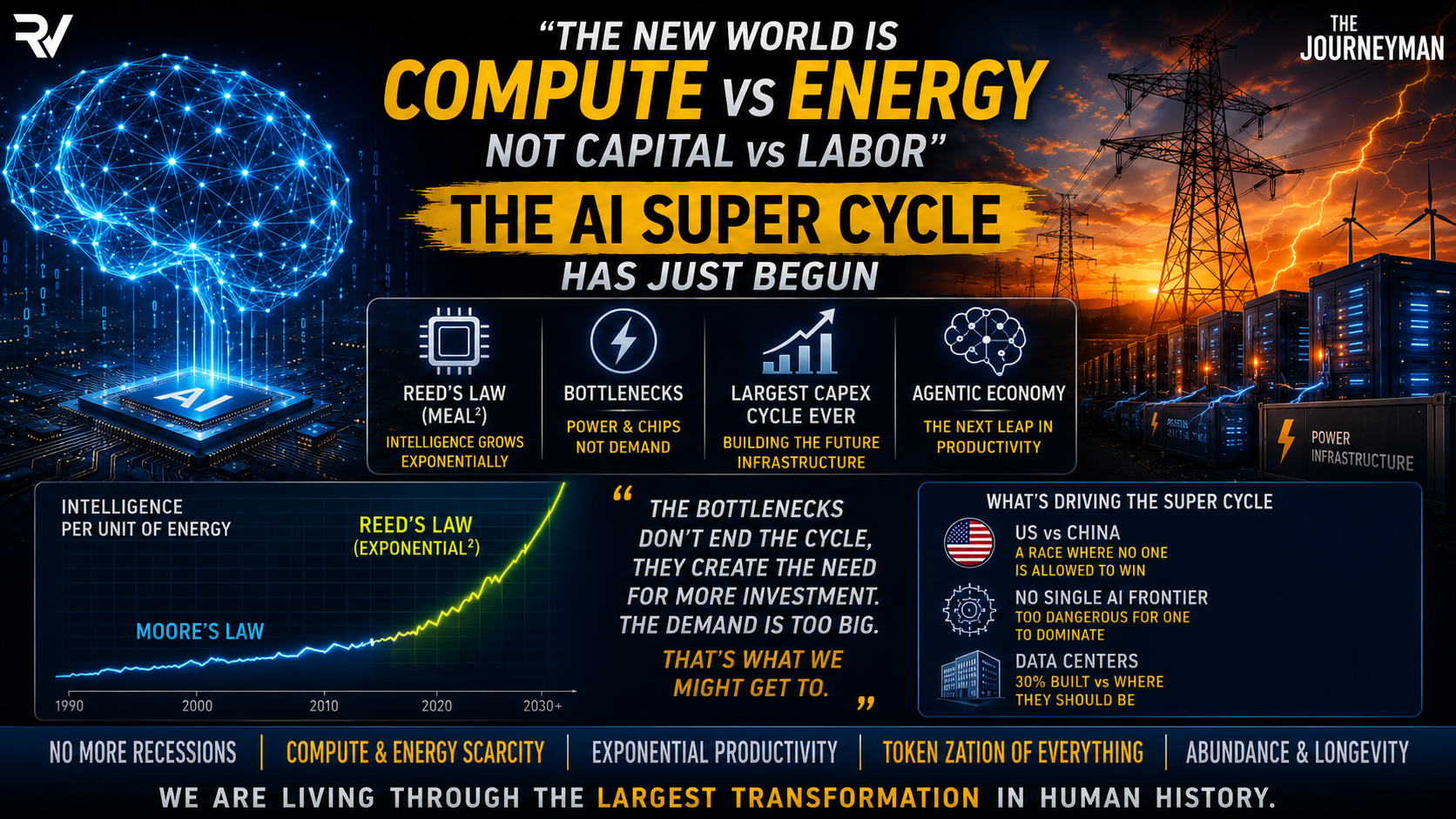
Lisa Tamati reporting on the conversation between two of the most brilliant macro analysts and AI experts: Raoul Pal and Jordi Visser.
A personal note
I've had the privilege of having Jordi Visser on my show twice. Watch the conversations here:
The Conversation That Explains Everything
When Raoul Pal and Jordi Visser get together, the conversation cuts through the noise to the foundational shift happening in real time:
The traditional business cycle is ending. And we're entering something that's never happened in human history.
This isn't hyperbole. It's the logical conclusion of what happens when artificial intelligence follows Reed's Law — exponential growth squared — something that has never existed in biology, not even in viruses.
"Reed's law, which is n-squared, has never existed in biology. It doesn't exist. And now we're seeing it and it's everywhere, which is why it's so hard to understand." — Raoul Pal
Understanding this shift changes everything about how you position capital for the next decade.
The Shift: From Capital vs Labor to Compute vs Energy
For 200 years, the business cycle worked like this:
Expansion: Companies borrow capital → hire labor → build factories → increase capacity → demand slows → margins compress → layoffs → recession.
Credit cycles drove everything. When credit expanded, you could hire. When credit contracted, you had to fire.
That cycle is over.
"The new world is: if we can't actually make all the chips we need and we can't actually get the power we need, you end up with a demand versus supply mismatch. The bottlenecks themselves may slow the earnings of these companies. Not because the demand is not there, because the demand is too big." — Jordi Visser
The new constraint isn't labor. It's compute and energy.
AI agents don't hire, don't buy houses, don't need healthcare (beyond software maintenance), don't have families. They consume one thing: compute.
This changes the bottleneck. It changes the business cycle. It changes everything.
Reed's Law: The Exponential Squared
For context on why this is so hard to understand:
Reed's Law says the utility of a network grows as n-squared (where n = number of nodes). This has never existed in natural biology because biological reproduction doesn't work that way.
But AI does.
Each AI system makes itself smarter. Smarter AI systems solve more problems. More problems solved = more intelligence generated = more self-improvement. It's a feedback loop that creates double exponential growth.
"We've never seen this before." — Raoul Pal
This is why linear thinking breaks. This is why "AI is a bubble" arguments fail. Traditional S-curve adoption doesn't apply when you have recursive self-improvement.
The Agentic Economy: A Marketplace of Billions
Here's where it gets genuinely mind-bending:
Billions of AI agents are about to enter the economy. Each agent can:
- Think independently
- Solve problems
- Create value
- Transact with other agents
And humans won't see most of it.
"The TAM has gone to infinity, which people have never understood. The TAM was always humans, right? And now the TAM is infinity." — Jordi Visser
"What [Jensen Huang] did when the agentic world comes — people haven't made the connection that we're talking about billions of thinkers entering the world, and they consume only one thing: compute." — Jordi Visser
This is the largest marketplace on Earth. And it's invisible.
Humans see maybe 1% of the transactions. 99% happens between AI agents, at machine speed, creating value you'll never directly observe.
The Capital Expenditure Cycle: Largest in Human History
This invisible marketplace has massive infrastructure requirements:
Data centers need to be built. Not in 10 years. Now.
Power grids need to be upgraded. The constraint is energy, not money.
Semiconductors need to be manufactured. TSMC, Samsung, Intel Foundry are all running at 100% capacity and still can't meet demand.
"Data centers are 30% built versus where they should have been." — Analysis from the conversation
The capital allocation flowing into solving these constraints will be the largest capex cycle in human history.
Not because companies are greedy. Because the bottlenecks won't allow anything else.
"What that bottleneck does is concentrate capital into that particular issue." — The conversation
Energy. Semiconductors. Networking. These become the only investments that matter for the next 3-5 years.
The End of Recessions (Maybe)
Here's the radical implication both speakers are circling:
If business cycles are driven by labor hiring/firing and credit expansion/contraction, and neither of those things matter anymore because AI agents do the work...
Do recessions still exist?
"No more recessions." — The implication in the conversation
This doesn't mean the market can't correct. It doesn't mean volatility disappears. But the traditional recession mechanism (labor layoffs → reduced consumption → debt defaults → financial crisis) may be obsolete.
Instead, you get:
Compute recessions: When demand for compute exceeds supply so dramatically that prices spike and some AI workloads can't get resources.
Energy recessions: When power generation can't keep up and infrastructure becomes the constraint.
These are different animals than labor-based recessions.
Intelligence as a Platform, Not Software
Raoul makes a critical distinction that reframes everything:
"Intelligence is not software. Intelligence is intelligence. And it can have any output that you want or any input that you can give it." — Raoul Pal
This means you're not buying "ChatGPT." You're buying a general intelligence engine that can be applied to anything.
Drug discovery. Financial analysis. System optimization. Robotics. Medicine. Coding. Teaching. The output is determined by how you deploy it.
This is why specialization (Eli Lilly's custom models) beats generalization (ChatGPT trying to be everything). A general intelligence trained on your proprietary data beats a general intelligence trained on the internet.
The Rotation: From Infrastructure to Applications to Crypto
The conversation maps a clear rotation path:
Phase 1 (Now): Build compute and energy infrastructure. Bottlenecks drive capital allocation.
Phase 2 (1-2 years): Applications begin to dominate. Eli Lilly and other companies with proprietary data + custom AI create defensible moats.
Phase 3 (2-5 years): The agentic economy matures. Billions of agents need settlement infrastructure. Crypto becomes essential.
"When earnings are great, you don't need crypto. What happens when earnings are now a two-sided market?" — The conversation
"I believe we're going to look back and realize that GLP1s were the ability to finance the next stage of the human software." — Implied from longevity/biotech discussion
Capital rotates from hardware → biotech/longevity applications → crypto infrastructure for agent settlement.
The Investment Implications
If this thesis is correct, your positioning should be:
Now (next 12 months)
- Long compute/energy infrastructure (bottleneck plays)
- Long semiconductor production capacity
- Long optical networking (co-packaged optics)
- Selective on memory (already priced in heavily)
1-2 years
- Rotate to applications with defensible moats
- Eli Lilly and specialized biotech benefiting from AI drug discovery
- Healthcare and longevity companies solving human problems with AI
- Exit commodity semiconductor plays
2-5 years
- Build positions in crypto infrastructure (crypto rails for agent transactions)
- Bitcoin as settlement layer
- Layer 1 blockchains for value coordination between agents
- Decentralized finance for machine-to-machine commerce
Long-term
- Companies built for the agentic economy will dominate
- Traditional labor-dependent business models will be disrupted
- Energy abundance becomes the strategic advantage
- Geographic locations with cheap power become economic centers
The Honest Uncertainty
Both speakers acknowledge the honest unknowns:
- Speed of adoption: How fast do agents actually enter the economy? (Could be 1 year or 10)
- Government response: Will governments try to regulate or tax AI development? Could slow buildout.
- Recursive self-improvement risks: Anthropic's warnings about self-improvement are real. If AI solves its own constraints (memory, energy), the entire capex thesis changes.
- Energy transition: Can we build renewable energy fast enough? If not, energy becomes the hard constraint, not chips.
- International competition: What happens if China's AI advances faster than the US? Geopolitical dynamics completely shift.
These aren't small risks. They're foundational uncertainties that could invalidate major parts of the thesis.
But the base case — that we're entering an unprecedented capital expenditure cycle driven by compute and energy constraints — seems robust to most scenarios.
The Bottom Line
Raoul Pal and Jordi Visser are describing a world that breaks most traditional frameworks:
- Business cycles ending (not weakening, ending)
- Total addressable market going from billions of humans to infinity (billions of agents)
- Bottlenecks shifting from labor to physics (chips, power, networking)
- The largest capital expenditure cycle in human history (not in decades — ever)
- New economic infrastructure requirements (crypto rails for agent transactions)
This isn't the AI hype you've heard before. It's rigorous macro analysis of what happens when exponential intelligence enters an economic system designed for linear growth.
The investment opportunities are massive. So are the risks.
The key is positioning for the rotation: from infrastructure discovery → application development → financial infrastructure for agents.
Get the sequence right, and the returns could be extraordinary.
Get it wrong, and you're caught holding infrastructure plays after the bottleneck solves itself.
Important Disclaimer
- This is analysis of macro conversations, not financial advice
- All positioning ideas are hypothetical and educational
- The agentic economy thesis is speculative and unproven
- Recursive self-improvement could invalidate the capex thesis
- Energy and geopolitical constraints could derail the timeline
- Consult a licensed financial advisor before investing
- Past performance doesn't guarantee future results
Lisa Tamati reports on macro cycles, AI economics, and the agentic transformation at PTLsignal.com
// newsletter
Want more like this?
Join the PTL Signal newsletter. Weekly AI, Bitcoin & market analysis from Lisa Tamati.