Pompliano & Visser: The Regime Shift Nobody's Ready For
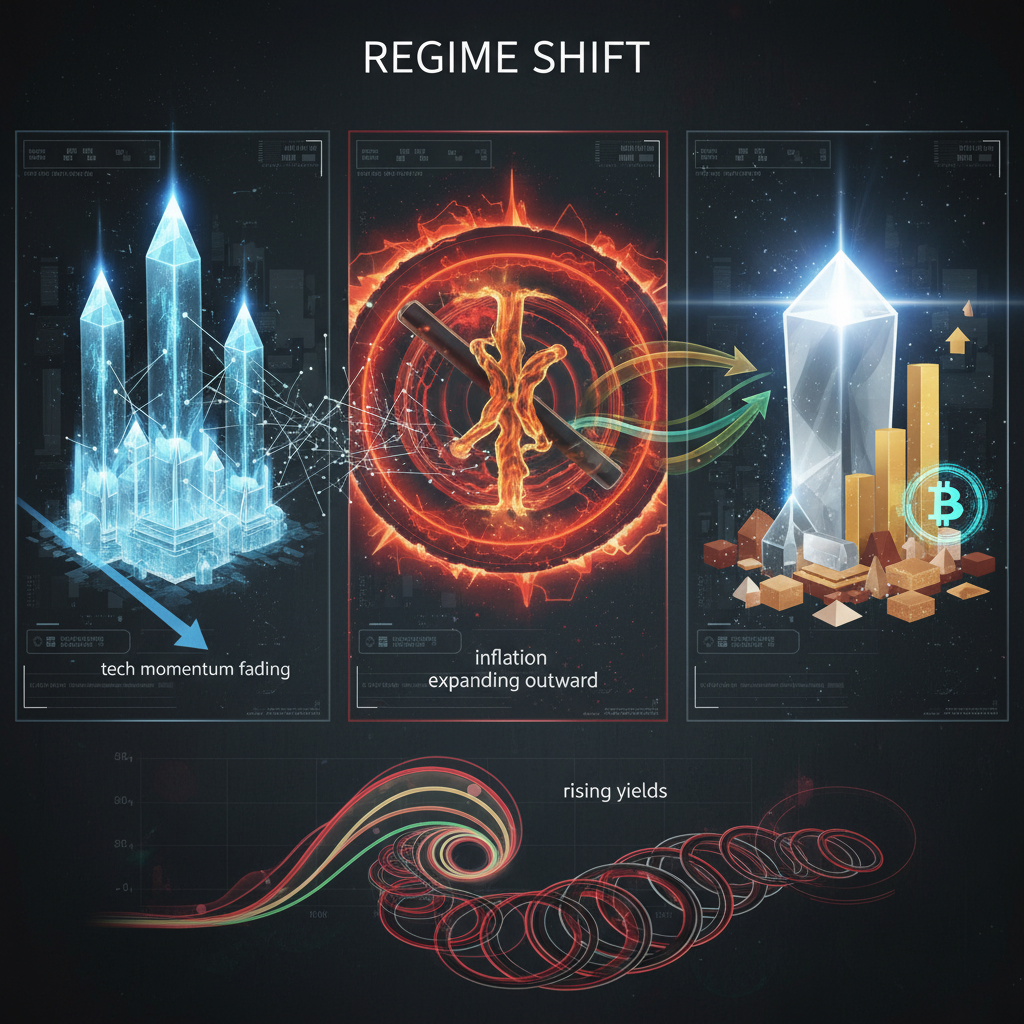
Lisa Tamati reporting on the conversation between Jordi Visser and Anthony Pompliano. For informational purposes only — not financial advice. All trade ideas discussed are hypothetical and educational. Consult a licensed financial advisor before making investment decisions.
The AI Goldilocks Narrative Is About to Break
The market believes we're in a perfect scenario: AI productivity is booming, rates are falling, earnings are expanding, and there's no inflation.
Jordi Visser, speaking with Anthony Pompliano, presents evidence that this narrative is about to shatter.
The catalyst isn't hypothetical. It's already happening in the Strait of Hormuz.
The Iran Oil Crisis: Structural, Not Transitory
This is the critical distinction Visser makes. Everyone assumes the Iran strait closure is temporary — like Russia-Ukraine or any previous geopolitical shock.
It's not.
"Once the situation in Iran became what it is and the strait shut down, the market started building in the likelihood that inflation was not only going higher this year, but the longer this has gone on, the expectations are that it's going to stay up here for longer."
Here's why it's structural:
In 2022, when Russia disrupted supply, the world had massive inventory buffers from COVID. We could absorb the shock. Today, we're burning through reserves with no strategic petroleum reserve buffer left.
The 3-month window that oil analysts modelled for "getting really bad" is closing.
When WTI moves above $98, it triggers systematic correlation breakdown globally. That forces the Fed into an impossible choice: fight inflation and crash the economy, or maintain financial stability and let inflation run.
The Cleveland Fed's May inflation estimate is above 4%. Year-over-year CPI is heading to 4.2%.
This is structural commodity inflation driven by geopolitics, not transitory labour costs.
The Tell: Correlations Breaking Down
This is where Visser's macro timing becomes precise.
Classic late-cycle signals are everywhere. The DRAM ETF ($MEM) hit $10 billion in assets under management in just 5 weeks. That's unprecedented retail capitulation into momentum.
But more critically: Japanese and Korean construction indices are breaking their 200-day moving averages while semiconductor names keep rallying.
When correlations break, it precedes major directional moves.
"Correlations are breaking down inside the markets. Construction index for Japan is about to break the 200-day moving average while we're here rallying in semis."
This isn't normal. This is the fragmentation of the AI infrastructure trade.
AI Momentum: Peak Performance, Exiting at 4–8x Gains
Visser has exited most of his semiconductor positions after 4–8x gains.
Why now?
"We're a year into that trade. Most of those names are up four to eight times. For me, going forward, the risk-reward has changed."
This is the institutional tell. When you can write papers about obvious trades — and Visser literally did — the alpha is dead. The retail pile-in into the DRAM ETF is the final warning shot.
The momentum trade that powered AI stocks is facing its first real test since the bubble began.
Silver: The Asymmetric Commodity Play
This is where Visser's conviction becomes extreme.
Silver demand from three sources creates a mathematically unsolvable supply crunch:
- AI components — Every semiconductor has silver in it
- Solar — Mandatory for renewable energy buildout
- China solid-state battery revolution — This is the big one
"March was the largest import month for China in history on silver. If solid-state replaces lithium over the next five years, the silver needs go up dramatically and we just don't have enough supply."
Unlike other commodities, silver has no substitutes in these applications.
China's record March imports signal they've done the math. They're positioning aggressively.
Visser's pattern recognition call: when silver breaks out, everything follows — gold, crypto, commodities — because it signals the end of the deflationary AI narrative and the beginning of inflationary supply constraints.
The Debt Spiral: 30-Year Yields at 25-Year Highs
The Iran crisis front-loaded inflation expectations, pushing long-term yields higher globally.
Japan and the UK hitting 25–30 year highs on their 30-year yields is the canary in the coal mine. These are heavily indebted economies facing the same math that's about to hit the US.
US interest expense: $1.4 trillion annually. That number has doubled from where it was five years ago.
At these levels, any meaningful yield spike creates a debt spiral. The government can't raise rates without triggering financial crisis. This forces eventual yield curve control — which is rocket fuel for hard assets and crypto.
The Trade Structure
If you believe the regime shift is imminent, Visser's framework points to three positions:
Silver Bull Call Spread (Asymmetric Play)
Buy $30 calls, sell $40 calls, 6-month expiry. Max profit: $10 per spread (less ~$3–4 premium). Max loss: premium paid. Breakeven: $33–34. This plays the supply crunch with defined risk and leverage.
Bitcoin Protective Collar (Volatility Hedge)
Own BTC, buy $50K puts (downside protection), sell $90K calls (fund the hedge). Max profit: limited to $90K minus cost. Max loss: protected at $50K. This protects against downside while capturing negative real yield upside.
Micron Put Spread (Momentum Trade Exit)
Buy $100 puts, sell $85 puts, 3-month expiry. Max profit: $15 per spread (less ~$4–5 premium). Max loss: premium paid. Breakeven: $95–96. This plays the correlation breakdown as semiconductor momentum peaks.
What This Means
Visser and Pompliano are calling an imminent regime shift from AI-driven euphoria to commodity-driven stagflation.
The catalyst is structural: Iran's control of the Strait of Hormuz creates permanent oil supply constraints. This forces inflation higher and keeps it there.
The signal is clear: when silver breaks out, it confirms the regime shift. When that happens, money rotates from momentum tech into hard assets, commodities, and crypto.
The market still believes in the AI Goldilocks narrative. But the math — inventory depletion, geopolitical permanence, debt spirals — suggests that belief is about to be tested.
This is analysis of a macro conversation — not financial advice. All trade ideas are hypothetical and educational. Geopolitical situations can change rapidly. Options strategies carry significant risk. Commodities are volatile; supply/demand forecasts can fail. Consult a licensed financial advisor before trading. Past performance doesn't guarantee future results.
Lisa Tamati reports on macro strategy and markets at PTLsignal.com
// newsletter
Want more like this?
Join the PTL Signal newsletter. Weekly AI, Bitcoin & market analysis from Lisa Tamati.