What Our AI Earnings Call Analyzer Made of Raoul Pal and Julien Bittel's Macro Thesis
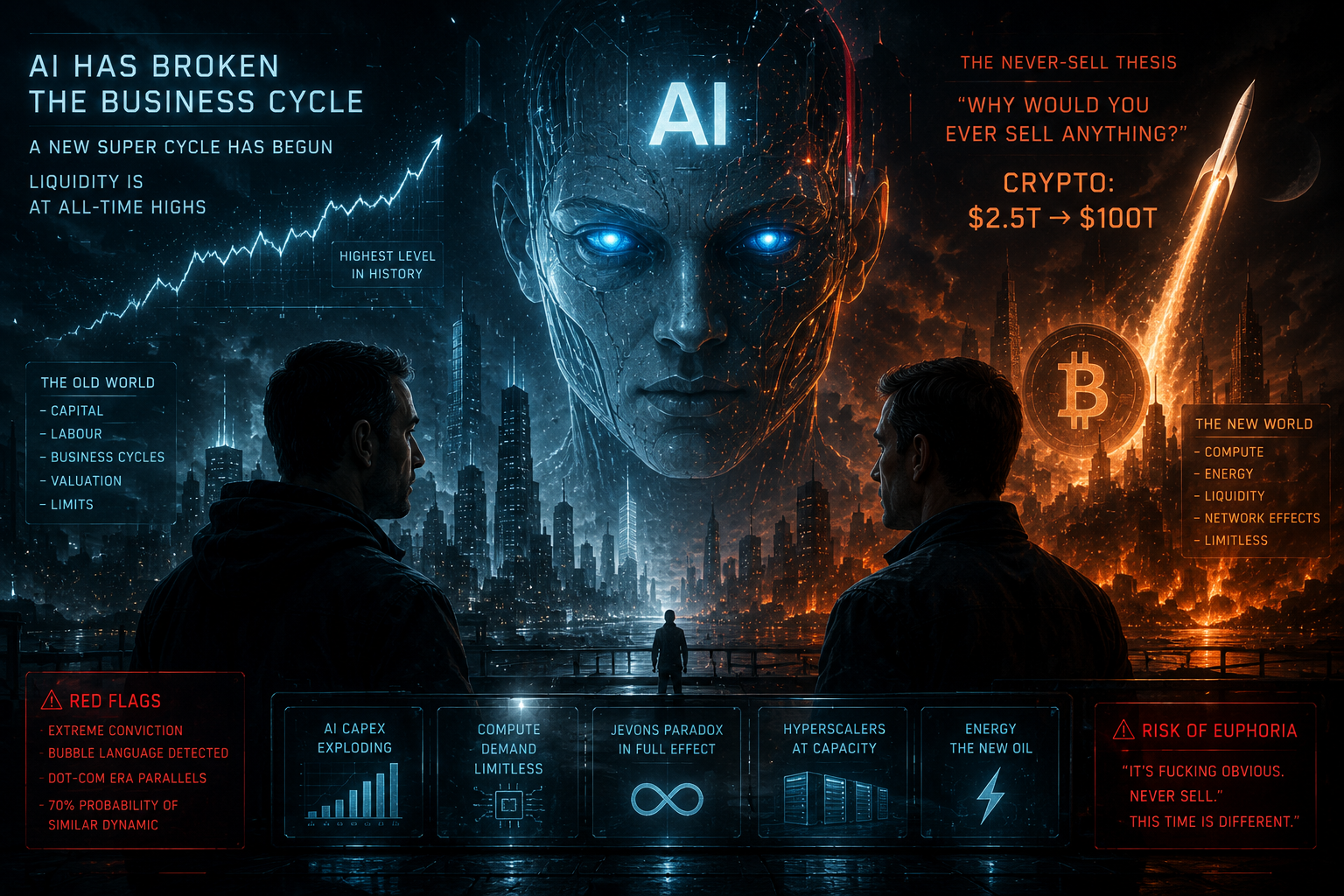
I ran the latest Raoul Pal and Julien Bittel conversation through our Earnings Call Analyzer — and the AI had some strong opinions.
Before I get into what the AI found, some context on who these two are, because their track records matter when evaluating the weight of their claims.
Raoul Pal is a former Goldman Sachs hedge fund manager who co-founded Real Vision, one of the most influential financial media platforms in the world. He's been one of the loudest voices in the macro space for over a decade, known for big sweeping calls — he was early on Bitcoin, early on the liquidity thesis, and has built a massive following by framing complex macro dynamics in accessible terms. He's also been wrong on timing more than once, and his pivot from cautious macro analyst to full-throated crypto evangelist over the past few years has divided opinion. Some see it as conviction. Others see it as capture. Either way, when Raoul talks, institutional money listens.
Julien Bittel is the Head of Macro Research at Global Macro Investor, Raoul's research arm. He's the quant behind a lot of the liquidity models and data frameworks that underpin the Real Vision thesis. Where Raoul paints in broad narrative strokes, Bittel provides the data architecture — the charts, the correlations, the positioning data. He's more measured in tone but fully aligned with the thesis. Think of him as the engine room to Raoul's bridge.
Together, they represent a particular school of macro thinking: liquidity-driven, cycle-aware, and increasingly AI-and-crypto-maximalist. Their recent conversation laid out what they believe is the defining investment thesis of the next decade. So I put it through our Earnings Call Analyzer to see what an AI with no position, no ego, and no confirmation bias would make of it.
For those unfamiliar, our Earnings Call Analyzer is an AI-powered tool that takes any financial conversation or earnings call transcript and produces an institutional-grade analysis report. It doesn't just summarise what was said. It assesses sentiment, identifies red flags, generates trade ideas, matches arguments against historical patterns, evaluates what was omitted, and produces a credibility assessment of the speakers. It's the kind of analysis that institutional desks pay serious money for — and we've made it available for free to founding members. Sign up to the PTL Signal newsletter at ptlsignal.com to get free founding member access.
I wanted to test it on something outside a standard corporate earnings call to see how it handled a macro thesis conversation between two well-known strategists. The results were fascinating — and I didn't agree with all of them.
The Core Thesis: AI Has Broken the Business Cycle
Pal and Bittel are making a sweeping argument that AI-driven capital expenditure has created what they call a "super cycle" — one so powerful it effectively renders traditional business cycle analysis obsolete. Their view is that we're in the middle of a fundamental phase transition, moving from a world dependent on capital and labour to one entirely dependent on compute and energy. They call it the biggest phase transition shift humanity has ever faced.
The evidence they cite is substantial. They point to Anthropic reportedly scaling from zero to $100 billion in revenue in just three years — a pace of growth that has no historical precedent. They reference global liquidity at all-time highs, US total liquidity including bank loans showing a clear upturn, and the Treasury General Account drawdown providing additional stimulus. Hyperscalers are reporting compute shortages. Jevons paradox — the idea that efficiency gains increase rather than decrease total demand — is in full effect.
From this foundation, they build to what is essentially a never-sell thesis. If crypto is going from $2.5 trillion to $100 trillion, why would you ever sell anything? You would just keep finding opportunities where assets get oversold and buy more, because that's where it's going. The logic is compelling. If the destination is clear, the path becomes about accumulation, not timing.
What the Analyzer Flagged: Language Patterns
This is where it gets interesting, because the AI isn't evaluating whether the thesis is correct — it's evaluating how the thesis is being communicated and what the communication patterns tell us about conviction levels and risk awareness.
The analyzer picked up on phrases like "it's obvious," "why would you ever sell anything," and "never sell" as markers of extreme conviction. Now, anyone who's watched Raoul for more than five minutes knows that colourful language and strong conviction are just how he communicates — it's part of what makes him compelling. The AI doesn't have that context. It reads language patterns in isolation and flags high-conviction language as a risk indicator by default.
That's actually one of the interesting things about running conversations through the tool — it shows you where the AI's pattern recognition is useful and where it lacks the human context to interpret what it's seeing. Sometimes extreme conviction is a warning sign. Sometimes it's an experienced strategist who's done the work and is simply telling you what he sees. Part of the value of the tool is that it forces you to make that distinction yourself rather than just absorbing the narrative.
The sentiment analysis gave an overall tone of "very positive" with confidence rated "high." The credibility assessment noted "high technical competence" — which tracks. These are serious strategists with deep domain expertise. The spin-to-substance ratio came in at 8 out of 10, meaning the AI judged the conversation as heavily narrative-driven relative to verifiable evidence. I'd push back on that somewhat — macro thesis conversations are inherently more narrative than a corporate earnings call, so the tool's calibration here is comparing apples to oranges. But it's still a useful data point.
What Was Missing: The Omissions Question
Sometimes what isn't said matters as much as what is. The analyzer flagged an absence of downside scenarios, valuation metrics, or bear cases in the conversation. No discussion of P/E ratios. No detailed consideration of what happens if AI capex demand plateaus. No explicit stress-testing of the thesis against adverse scenarios.
In the analyzer's framework, this kind of omission is a signal worth noting. I'd add some nuance here — this was a conversation, not a risk report. Pal and Bittel have addressed downside scenarios elsewhere, and you can't cover everything in a single discussion. But the analyzer doesn't have that context. It analyses what's in front of it, and what was in front of it was a strongly bullish thesis with limited counter-argument.
That said, even if you're confident in the direction — and I think the direction is sound — there's value in articulating what would change your mind. Not because you're wrong, but because it sharpens the thesis. The best macro thinkers I follow hold strong convictions while remaining specific about what would challenge those convictions. It's not weakness — it's intellectual rigour.
The Geopolitical Dependency
One of the most striking elements of the conversation was how heavily the thesis depends on geopolitical cooperation. Pal and Bittel argue that Trump is going to negotiate a "grand bargain" with China — lower dollar in exchange for China buying the long end of the Treasury curve, with some agreement over access to Nvidia chips, all designed to avoid conflict over Taiwan.
The analyzer flagged this as a key dependency, noting that the AI capex thesis relies significantly on this cooperation materialising. It drew a parallel to trade war optimism cycles between 2018 and 2020, when markets repeatedly rallied on hopes of a deal only to see setbacks. The analyzer assigned a 60% probability of similar complications.
I think this is one of the more valid concerns the analyzer raised. Geopolitics is inherently unpredictable. Taiwan tensions, technology transfer concerns, domestic political pressures on both sides, and national security considerations around advanced chip access all create friction points. That doesn't mean a deal can't happen — it means the path to a deal is unlikely to be smooth, and positioning that assumes smooth resolution carries risk.
If the grand bargain takes longer than expected — or arrives in a form that disappoints markets — the timing of the thesis shifts even if the direction remains correct. And in markets, timing matters for portfolio construction even when direction is clear.
Crowded Trades and Liquidity Dependency
Even within the conversation itself, there were moments that the analyzer seized on. The hosts acknowledged that copper positioning is extremely crowded — "every hedge fund I know is long" — with speculative positioning very stretched as a percentage of total open interest.
The analyzer flagged this as worth watching. When positioning is this one-sided, the unwind can be sharp regardless of whether the fundamental thesis is correct. This isn't a bearish call on copper or the commodities super cycle — it's a positioning observation. Crowded trades can be right and still produce painful drawdowns along the way.
The broader liquidity dependency was also noted. Pal and Bittel rely heavily on liquidity correlations — the idea that as long as global liquidity is expanding, risk assets will perform. The correlation has worked well, and their models have a strong track record. The analyzer's caution here is simply that all models have boundary conditions, and understanding where your model might break is as important as trusting it when it's working.
The Trade Ideas the Analyzer Generated
Based on its assessment, the analyzer generated several trade ideas — not as recommendations, but as logical positions given the risks it identified.
It suggested a medium-conviction short on NVDA, noting that geopolitical risks around China chip access remain while the stock has run hard. It proposed a pair trade of long QQQ against short copper miners, capturing tech upside while hedging against the crowded commodity positioning. And it suggested a low-conviction short on Bitcoin based on its reading of positioning sentiment.
It also generated options strategies — an NVDA put spread taking advantage of elevated implied volatility, and a QQQ iron condor to collect premium if markets range-bound near highs. These are the kinds of institutional-level hedging strategies that the tool surfaces automatically from any conversation it analyses. Whether you'd take them depends entirely on your own thesis and risk management framework.
Historical Pattern Matching
The analyzer drew two historical parallels worth noting.
The China grand bargain optimism matched 2018–2020 trade war cycles, where repeated optimism met repeated setbacks before eventual progress. Probability of similar complications: 60%.
The liquidity correlation reliance was compared to quant models that assumed stable relationships between variables. The analyzer assigned a 40% probability of correlation stress at some point in the cycle.
These parallels don't invalidate the thesis. They highlight specific assumptions that have been tested before, and they suggest that the path from here to where Pal and Bittel expect things to go may not be as linear as the conviction level implies. That's useful context for position sizing and risk management, even if you agree with the destination.
Where I Agree and Where I'd Push Back on the AI
I want to be transparent about where I land on this, because the point of running these analyses isn't to blindly accept what the AI says — it's to use it as a thinking tool.
I agree with Pal and Bittel that AI is genuinely transformative and that the capex cycle is structural, not speculative. I agree that liquidity dynamics drive asset prices and that the crypto market has significant room to grow. The macro direction they're describing feels right to me.
Where the analyzer adds value is in highlighting the assumptions embedded in the thesis — the geopolitical dependency, the crowded positioning in certain trades, the liquidity model's boundary conditions. These aren't reasons to disagree with the thesis. They're reasons to think carefully about how you're positioned for the scenarios where the thesis is right on direction but the path gets bumpy.
And where I'd push back on the AI is on some of its language analysis. Raoul's communication style is Raoul's communication style. The analyzer reads conviction as a warning by default, and sometimes conviction is just a strategist who's done the work and is being direct about what he sees. The tool can't distinguish between the two — that's your job as the reader.
Why This Kind of Analysis Matters
This is exactly why we built the Earnings Call Analyzer. Every investor listens to calls and conversations through their own confirmation bias. If you're bullish on AI and crypto, Pal and Bittel's conversation sounds like validation. If you're cautious, it sounds aggressive. Neither reaction is analytical.
The AI doesn't have a position. It doesn't own NVDA. It doesn't hold Bitcoin. It doesn't care whether the thesis is right. It looks at the language, the structure of the argument, what's present and what's absent, and maps all of it against historical precedent. Then you take that output and apply your own judgment. That's the edge — not replacing your thinking, but pressure-testing it.
Whether you agree with Pal and Bittel or not, having a tool that stress-tests narratives before you allocate capital is the kind of edge that used to be reserved for institutional desks with six-figure Bloomberg terminals and teams of analysts. Now you can run any earnings call, any investor conversation, any macro thesis through the same analytical framework in minutes.
Sign up to the PTL Signal newsletter at ptlsignal.com and get free founding member access to the Earnings Call Analyzer. Run your own calls. Stress-test your own convictions. Because the most expensive bias is the one you don't know you have.
// newsletter
Want more like this?
Join the PTL Signal newsletter. Weekly AI, Bitcoin & market analysis from Lisa Tamati.