Stagflation 2.0: Why Jordi Visser Thinks This Is the 1970s With an AI Twist — and What It Means for Bitcoin
I've been following Jordi Visser's recent appearances closely — his Substack, his X posts, and his conversations with Anthony Pompliano — and a new layer has emerged on top of the private credit thesis I covered in my last post. This one is more urgent, and frankly more unsettling.
The short version: Jordi believes we are walking into a 1970s-style stagflation environment. Not because history is repeating cleanly, but because the underlying mechanics are eerily similar — with one critical modern twist that makes this version stranger and harder for policymakers to navigate.
If he's right, most investors are positioned completely wrong.
The Commodity Bull Market Nobody's Talking About
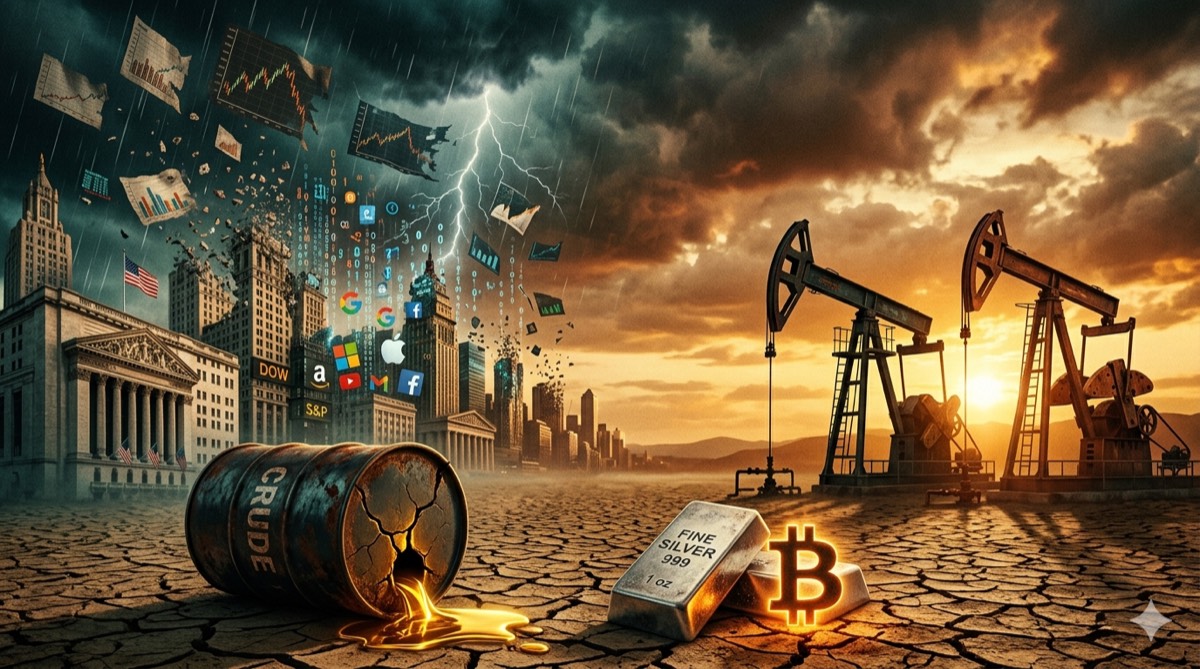
While financial media has been fixated on AI stocks and crypto sentiment, something significant has been happening in the background. Silver is up 60% from six months ago. Copper is up 20%. DRAM prices have surged 500%. And now oil has joined the party — up over 60%, with Asian markets pricing Oman and Dubai crude near $170 a barrel.
Jordi's read is that this isn't just a geopolitical blip. This is a commodity bull market that predates the current Middle East conflict. The Iran situation accelerated it, but the structural supply-demand imbalance was already there. Energy had simply lagged behind metals — and now it's catching up.
"This is a commodity bull market. I think oil had lagged behind these other metals."
The 1970s parallel is deliberate. That decade delivered a multi-year commodity supercycle that destroyed traditional equity valuations, crushed growth stocks, and rewarded anyone holding real, scarce assets. Jordi sees the same dynamics playing out now, potentially running five to ten years.
The AI Deflation vs Oil Inflation Battle
Here's where it gets philosophically interesting — and genuinely difficult for policymakers.
On one side you have a deflationary force: AI is aggressively compressing costs across knowledge work, software, and services. Entire product categories that cost tens of thousands of dollars a year are being replicated in minutes. He points to the Bloomberg terminal — a $30,000 annual subscription — as a canary. Tools like that face existential pricing pressure from AI systems that can replicate their core function for near-zero cost.
On the other side, you have an inflationary force: oil and commodities driving up the cost of physical goods, energy, and manufactured products.
The Fed is caught in the middle. Raise rates to fight headline inflation from oil, and you accelerate the AI-driven deflation that's already destroying software valuations and knowledge-economy jobs. Let inflation run, and you risk political fallout as real costs bite. Jordi's view is that the Fed will ultimately prioritise fighting AI deflation over controlling headline commodity inflation — which means extended easy monetary policy despite what the official CPI numbers suggest.
"Bitcoin is going to explode out of here once we get to the realisation that the Fed is going to be focused on the deflation side, not on the inflation side."
Software Is Facing Something Structural, Not Cyclical
Jordi uses the VHS-to-DVD analogy: incumbent technology companies appear stable for longer than you'd expect, maintaining revenue and user bases — right up until they don't. The cliff decline, when it comes, is sudden. AI is following that classic S-curve disruption pattern, but compressed. The transition from "this is interesting" to "this destroys your business model" is happening in months, not years.
For software companies, this means permanent margin compression. Pricing power disappears as AI creates functional equivalents. Growth projections that justified premium valuations no longer hold. He's not talking about a cyclical dip in software — he's talking about a structural re-rating that doesn't reverse.
The practical implication is significant for anyone building in the tech space right now. The software-as-a-service model that defined the last decade of venture capital is under genuine structural pressure.
The Overlooked Risk: Helium
This one caught my attention because it's the kind of detail that gets missed until it's too late.
There was a major attack on a facility in Qatar responsible for over 35% of global helium supply. Helium is a critical component in semiconductor manufacturing — used in cooling systems, fiber optic production, and chip fabrication. It's not substitutable on short notice.
Jordi flagged this as a major red flag that markets have almost completely ignored, drawing the parallel to early COVID when supply chain vulnerabilities were visible but systematically dismissed.
"I think institutional investors are paralysed. I think the sell side is paralysed."
That paralysis creates asymmetric opportunity for those paying attention.
Bitcoin's Perfect Storm
Jordi has been pounding the table on Bitcoin throughout all of this, and his reasoning is more nuanced than the standard debasement hedge argument.
Bitcoin is benefiting from this environment through multiple channels simultaneously:
- → The commodity supercycle grants it a scarcity premium — Bitcoin's fixed supply puts it in the same conceptual category as silver, oil, or copper
- → The Fed's likely pivot toward fighting AI deflation creates the monetary expansion conditions that have historically driven Bitcoin's biggest moves
- → Private credit stress adds a third catalyst — when that liquidity event hits, the post-stress recovery historically flows into hard assets and Bitcoin specifically
"I'm going to keep pounding the table that the best thing for Bitcoin is a continuing credit problem which I don't think can be resolved on its own — and at the same point having a commodity bull market."
His price target in this environment: $150,000 over an 18-month horizon as an initial target, with the longer supercycle thesis pointing considerably higher.
The George Costanza Moment
One of the more memorable frames from his Pompliano conversation was invoking the Seinfeld character who discovered that every instinct he'd ever had was wrong — so he started doing the opposite of whatever felt natural, and his life transformed.
Jordi's point: after last year's tariff panic that proved overblown, institutional investors have been conditioned to dismiss fear as noise. The contrarian position now is to take the real supply disruptions seriously precisely because consensus is ignoring them.
"This is like a George Costanza do the opposite moment."
What This Means for How I Think About Health
I keep coming back to the parallel between financial fragility and physical fragility, because they follow the same dynamics.
Jordi's thesis is fundamentally about systems under stress. Highly leveraged, interconnected systems — whether private credit markets or supply chains — that look stable right up until they don't. The stagflation environment he's describing creates winners and losers not based on intelligence or effort, but on whether you hold assets that are scarce and real versus assets that are abundant and replicable.
The same logic applies to health. The people who will weather the stress of the coming decade — economically, physically, mentally — are the ones who've built genuine resilience rather than relying on systems that work fine until they don't. Your metabolic flexibility, your HRV baseline, your mitochondrial health — these are your real assets. They can't be inflated away or replaced by an AI agent.
Build what can't be copied. Own what can't be inflated. That's the thesis, whether you're talking about Bitcoin or your biology.
The Positioning Implication
Jordi's suggested allocation in this environment leans heavily toward commodities and energy, Bitcoin as a macro hedge, and meaningful cash to deploy during volatility. He's negative on software and broadly cautious on anything that derives its value from knowledge work that AI can replicate.
The cash position isn't timidity. It's optionality. In an environment this volatile, the ability to act when others are paralysed is itself a scarce asset.
I'm watching all of this closely. The private credit thesis, the commodity supercycle, the helium supply chain story, the Fed's impossible dilemma. Each thread reinforces the others.
Jordi's been early and right on too many of these calls to dismiss. The turbulence model is flashing, and the commodity bull market is already in motion.
The question isn't whether the storm is coming. It's whether you're prepared.
// newsletter
Want more like this?
Join the PTL Signal newsletter. Weekly AI, Bitcoin & market analysis from Lisa Tamati.