The Terrafab Gambit: When 50x Compute Meets the End of Human Driving
Peter Diamandis doesn't do small. The man who launched the XPRIZE and built Singularity University into a cathedral for exponential thinkers has spent decades teaching the world to think in 10x leaps rather than incremental gains. So when he gathered his regular panel of heavy hitters for the latest Moonshots podcast, I knew we were in for something special.
Dave Blundin — DB2 to those who know him — brought his characteristic tech investor swagger, the kind earned from backing winners before the crowd catches on. Alex Wiesner-Gross, the physicist-turned-AI-researcher with a mind that seems to operate several clock speeds faster than mere mortals, came ready to connect dots others haven't even noticed yet. And Salim Ismail, whose book "Exponential Organizations" became required reading for anyone trying to build in the age of accelerating returns, brought his framework for understanding how technology reshapes institutions.
This wasn't casual banter over coffee. This was four minds who spend their waking hours tracking the bleeding edge of human capability, unpacking a week that felt less like seven days and more like seven years of compressed change. What emerged wasn't just analysis — it was a map of the near future, sketched in real-time by people who are actively building it.
I've been covering this space long enough to know when something fundamental is shifting beneath the surface. This was one of those moments.
The Terrafab Gambit: Elon's 50x Compute Play
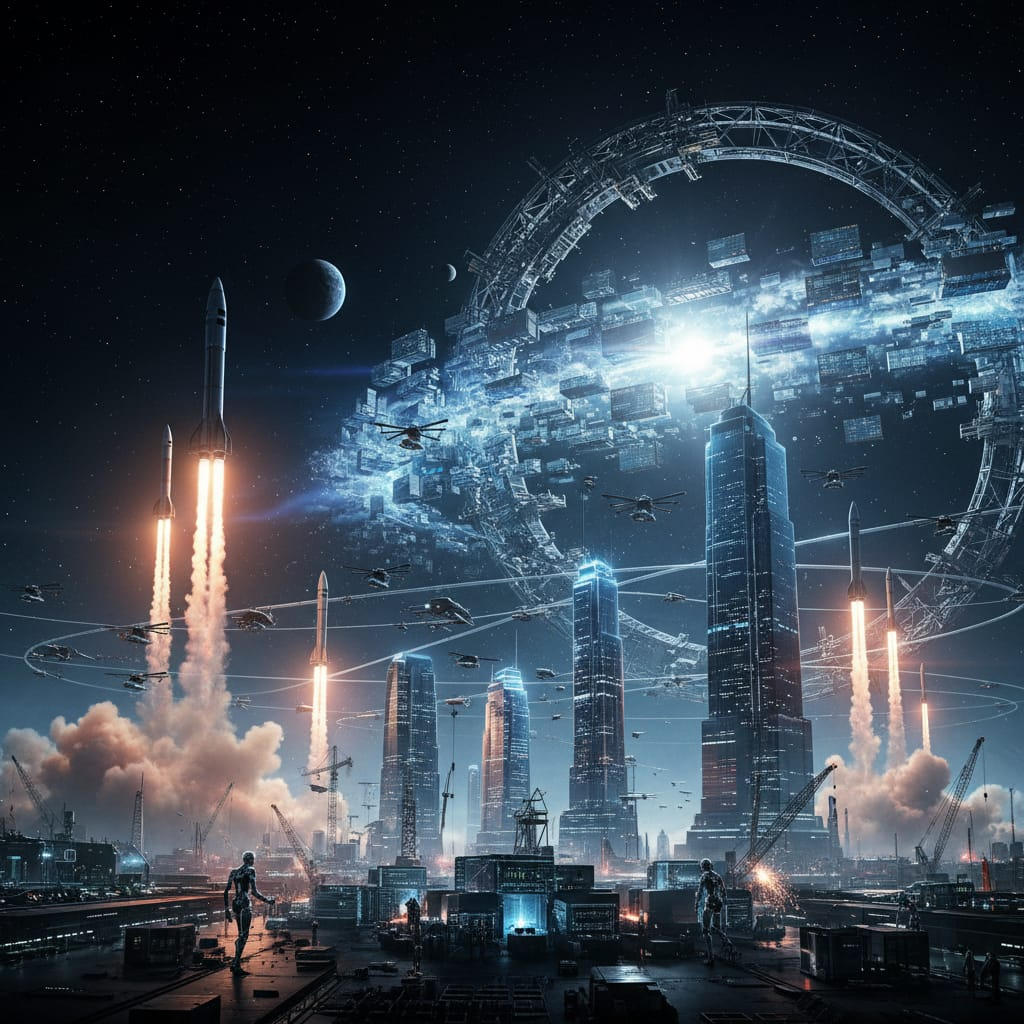
Diamandis opened with a number that should have required a drumroll: one terawatt. That's not a typo. One terawatt of AI compute capacity per year. To put this in perspective, that's roughly fifty times the entire current global AI compute output. Elon Musk's Terrafab project isn't just ambitious — it's the kind of ambition that makes other ambitious projects look like hobbyist tinkering.
The price tag? A cool $25 billion in initial capital expenditure. But here's where Wiesner-Gross jumped in with the kind of physics-based reality check that cuts through the hype. "We're not talking about building a bigger data center," he pointed out. "We're talking about an entirely different scale of industrial operation." The numbers he laid out were staggering: to support this level of compute deployment, SpaceX would need to launch 274 Starship flights per day. Every single day. That's a launch rate that makes the Apollo era look like a model rocket club.
Blundin leaned into the economic implications with the enthusiasm of someone who's seen this movie before. "This is classic Elon," he argued. "Everyone focuses on the capex number and misses the strategic positioning. If you control the compute layer for the next wave of AI, you don't just participate in the revolution — you define its parameters." The Terrafab play isn't about meeting current demand; it's about creating supply so massive that it fundamentally changes what AI can do.
Ismail brought his organisational lens to bear, and his analysis was characteristically sharp. "We've seen this pattern before," he emphasised. "The companies that win exponential transitions aren't the ones who optimise for the current paradigm. They're the ones who bet that the constraint everyone assumes is fixed — compute availability, in this case — can actually be shattered." Musk isn't just solving for more GPUs. He's solving for a world where compute scarcity disappears entirely.
What struck me listening to this discussion was the sheer audacity of the vision. Most companies are still debating whether to adopt AI tools. Musk is building infrastructure that assumes AI will be as ubiquitous as electricity — and he's doing it at a scale that makes that assumption self-fulfilling. According to the panel, this isn't just about training bigger models. It's about creating the substrate for intelligence to become as distributed and accessible as the internet itself.
The implications cascade outward. If compute becomes effectively infinite, the cost of intelligence approaches zero. If the cost of intelligence approaches zero, every industry that relies on human cognition — legal, medical, creative, analytical — faces the same disruption that manufacturing faced when automation arrived. The Terrafab isn't just a hardware project. It's a declaration of intent about the shape of the next decade.
The End of Human Driving
But compute abundance isn't just an abstract economic force. It's already manifesting in ways that are reshaping the physical world around us. Diamandis pivoted to autonomous vehicles with the energy of someone who's been waiting years for this particular future to arrive — and suddenly realised it's here.
Waymo has now logged 170 million autonomous miles. That number matters not just for what it represents in accumulated data, but for what it signals about regulatory acceptance and public trust. The autonomous vehicle transition isn't coming. It's arrived. And the panel's discussion of what happens next was where things got really interesting.
Wiesner-Gross made a prediction that landed with weight: "We're not far from the point where human driving becomes illegal in dense urban areas." Not discouraged. Not restricted. Illegal. The logic is brutal and simple: once autonomous vehicles prove statistically safer than human drivers — something that's already happening in the data — the argument for allowing error-prone humans to pilot two-ton metal projectiles through city streets becomes indefensible.
Blundin brought the economic dimension into focus with the Uber-Rivian deal. That $1.25 billion partnership isn't just about putting more electric vehicles on the road. It's about building the infrastructure for a world where personal car ownership becomes an anachronism. "Look at what happened to horses," he argued. "They're not illegal, but they're not practical for daily transportation either. We're approaching the same inflection point for personally operated vehicles."
Joby Aviation's EVTOL developments added another layer to this transformation. The third dimension of urban transit — airspace — has been largely ignored because human pilots make it economically unworkable at scale. Remove the human, and suddenly vertical takeoff electric vehicles become a viable solution to congestion that doesn't require billions in tunnelling or highway expansion. Ismail emphasised the cascading effects: "Every parking garage, every gas station, every urban planning assumption from the last century becomes obsolete when you remove the driver from the equation."
According to the panel, the real estate implications alone are staggering. Urban parking represents some of the most valuable real estate on the planet, currently dedicated to storing vehicles that sit idle 95% of the time. Autonomy transforms that dead space into — potentially — housing, parks, commercial development. Suburban assumptions about commute times and car dependency unravel. The entire built environment of the 20th century was designed around the automobile. The 21st century may be designed around autonomous mobility.
I've been tracking this space since the early days of the DARPA challenges, and there's always been a "someday" quality to the autonomous vehicle conversation. Listening to these four, I realised someday has become today. The technology works. The economics are tipping. The regulatory framework is adapting. The question isn't whether human driving ends — it's how fast.
The Great Reshuffle
As vehicles become autonomous, something equally profound is happening to work itself. Diamandis introduced what he called "The Great Reshuffle" — the systematic displacement of human labour by AI capabilities. PwC's recent research landed like a gauntlet: AI will automate 25% of work hours across the economy. Their message to businesses was blunt: adapt or die.
Wiesner-Gross brought a fascinating technical lens to this transition. He described how Jensen Huang — NVIDIA's CEO — has been tracking what he calls the "$250,000 token metric." The idea is simple: measure organisational performance by the value generated per AI token consumed. Companies that figure out how to deploy AI effectively are seeing productivity gains that make traditional efficiency improvements look trivial. Those that don't are facing what Ismail termed "organisational obsolescence."
The G42 announcement crystallised this shift in a way that made the abstract concrete. The Abu Dhabi-based AI company isn't just using AI tools — they're literally hiring AI agents as employees. These aren't chatbots answering customer service queries. These are autonomous systems with goals, budgets, and performance metrics, integrated into organisational workflows alongside human workers.
Blundin's take was characteristically direct: "We've been asking the wrong question. It's not 'how many jobs will AI eliminate?' It's 'what does an organisation look like when intelligence is no longer a constraint?'" The answer, according to the panel, is something fundamentally different from the corporate structures we've inherited from the industrial era. Hierarchy assumes that information and decision-making must flow through human nodes. When AI can process information and make decisions at machine speed, those hierarchies become bottlenecks rather than enablers.
According to the panel, the companies that navigate this transition successfully share a common trait: they're treating AI not as a cost-cutting tool but as a capability amplifier. The goal isn't to do the same work with fewer people. It's to do work that wasn't economically viable before — at scales that weren't achievable, with quality that wasn't possible, at speeds that weren't feasible. The reshuffle isn't just about displacement. It's about expansion of what's possible.
What haunts me about this discussion is the gap between the organisations that get this and the ones that don't. The PwC warning isn't theoretical. We're already seeing divergence between AI-native companies and legacy organisations trying to bolt intelligence onto structures designed for a different era. The gap isn't closing — it's widening exponentially.
When Moats Become Temporary
This acceleration has profound implications for how we value companies and build competitive advantage. Diamandis introduced Chamath Palihapitiya's "terminal value collapse" thesis, and the panel's discussion of it revealed the dark side of exponential change.
The traditional model of business value rests on the assumption of durable competitive advantage — moats that protect returns over time. But Wiesner-Gross pointed out the problem: "When technology cycles compress from decades to quarters, what does 'durable' even mean?" The moats that Warren Buffett built fortunes identifying — brand loyalty, regulatory capture, economies of scale — are evaporating faster than ever before.
Private equity multiples tell the story. Companies that once commanded 22x earnings are now trading at 2–7x. The compression reflects a fundamental uncertainty: will this business even exist in its current form five years from now? When AI can replicate capabilities, undercut pricing, and scale faster than incumbents can respond, the premium for market position disappears.
Ismail called this the "organisational singularity" — the point at which a company's ability to adapt becomes more valuable than any static advantage it possesses. "We've moved from a world where you won by building walls," he emphasised, "to a world where you win by dancing faster than everyone else." The companies that thrive aren't the ones with the strongest defences. They're the ones with the fastest feedback loops and the willingness to cannibalise their own success before someone else does.
Blundin added a crucial caveat: this doesn't mean all moats disappear. "Network effects are actually getting stronger," he argued. "The moats that survive are the ones that get deeper with scale — platforms, marketplaces, data flywheels. But traditional product advantages? Those are temporary by default now."
According to the panel, the investment implications are seismic. The skill that mattered for the past fifty years — analysing durable competitive position — matters less than the ability to sense shifts early and reallocate capital before the crowd catches on. Value investing in an exponential age requires different tools and different time horizons. The terminal value collapse thesis isn't just about lower multiples. It's about a fundamental reconsideration of what creates lasting value when everything is in flux.
The New Space Race & Panspermia
If the economic transformation seems dizzying, the panel's discussion of space pushed into territory that felt almost science fictional. Diamandis opened with the new space race: NASA and SpaceX versus China, with the moon as the first prize and 2030 as the deadline.
But Wiesner-Gross immediately expanded the frame beyond geopolitical competition. He brought up the Ryugu asteroid samples and the evidence suggesting that DNA's basic building blocks exist in space. "We're not just talking about flags and footprints," he pointed out. "We're talking about the possibility that life itself is distributed throughout the cosmos, and that the chemistry we associate with biology might be universal rather than unique to Earth."
This is panspermia — the idea that life spreads between worlds, hitching rides on asteroids and comets. For decades, it was fringe science. Now, with samples from asteroids showing amino acids and organic molecules, it's moving toward mainstream acceptance. According to the panel, the implications are staggering: if the precursors to life are common in the universe, then life itself may be common too.
Ismail connected this to the practical economics of space development. "Everyone focuses on Mars," he emphasised, "but the moon is where the real action is happening first." Lunar mining for helium-3 and rare earth elements isn't just science fiction — it's the foundation for building the infrastructure that could eventually support a Dyson sphere, the theoretical megastructure that would capture a significant portion of the sun's energy output.
Blundin's take on the China competition was sobering. "This isn't the Cold War space race," he argued. "That was about prestige and national pride. This is about resources and strategic position. The nation that controls lunar infrastructure controls the gateway to the solar system." The 2030 timeline isn't arbitrary — it's the point at which China's capabilities and ambitions converge.
According to the panel, what makes this moment different from previous space enthusiasm is the economic logic. SpaceX has already demonstrated that reusable rockets change the cost equation. Once lunar mining becomes economically viable, the expansion into the solar system becomes self-funding. The space race isn't just about planting flags — it's about establishing the industrial base for humanity's multi-planetary future.
I've been listening to space enthusiasts my whole career, and there's always been a "if only" quality to the conversation. If only launch costs were lower. If only government would commit. If only the economics worked. Listening to this panel, I realised those if-onlys are disappearing. The economics are starting to work. The commitment is emerging. The costs are falling. We're not talking about someday anymore. We're talking about this decade.
Models Go Underground
Back on Earth, the AI model landscape is undergoing its own transformation. Diamandis opened this section with the proliferation of model variants — GPT 5.4 mini and nano, the mysterious trillion-parameter model that appeared briefly before disappearing again, rumoured to be Xiaomi's Hunter Alpha project.
Wiesner-Gross brought his physicist's perspective to the trend. "We're seeing the commoditisation of intelligence," he observed. "The gap between frontier models and specialised distills is shrinking faster than anyone expected." Distillation — the process of training smaller models on the outputs of larger ones — is creating capable AI that runs on consumer hardware.
The Hunter Alpha mystery particularly fascinated Blundin. "The fact that it appeared and then disappeared suggests either a regulatory intervention or a strategic decision to keep capabilities hidden," he argued. "Either way, it tells us something important: the model landscape is more complex than the public narrative suggests." Chinese companies aren't just catching up — they're operating on different timelines and with different constraints than their Western counterparts.
Ismail emphasised the infrastructure implications. "When models can run anywhere, the bottleneck shifts from model access to compute access," he pointed out. "That's what makes Terrafab strategically significant. The model wars are becoming the compute wars." The companies that control the infrastructure for running AI — not just the models themselves — may capture more value than the model creators.
According to the panel, the trend toward smaller, specialised models is accelerating the democratisation of AI. A model that runs on a smartphone can be deployed in contexts where cloud connectivity is unreliable or surveillance is a concern. The "underground" models — those running locally, privately, without API calls to centralised services — represent a fundamentally different paradigm for how intelligence gets distributed.
Machines Building Machines
If AI is becoming ubiquitous, what's driving that ubiquity? The panel's discussion of AI-designed hardware pointed to a recursive loop that's both exhilarating and slightly terrifying.
Wiesner-Gross led with the most concrete example: an AI designed a RISC-V CPU in 12 hours that matched the performance of designs that traditionally required 90 days of human engineering. "This isn't incremental improvement," he emphasised. "This is a 180x speedup in a fundamental engineering task. And the AI-designed chip wasn't just faster to create — it was actually more efficient than human designs."
The implications cascade. AI-designed chips run AI more efficiently. More efficient AI designs better chips. Blundin called this "recursive self-improvement in the wild" — the feedback loop that singularity theorists have been predicting for decades, now manifesting in actual hardware.
Ismail brought organisational implications to bear. "What does it mean to be a hardware company when your competitive advantage comes from AI design tools rather than engineering talent?" he asked. The answer, according to the panel, is that the hardware industry is facing the same transformation that software underwent with the rise of cloud computing. The capabilities that matter most are shifting from craft expertise to orchestration and integration.
Diamandis added a note of caution amidst the enthusiasm. "We've seen acceleration before," he reminded the panel. "The question is whether these gains compound or plateau." But even his caution acknowledged something fundamental: the tools for building better tools have fundamentally changed. The pace of improvement in AI-designed hardware suggests we're in the early innings of a transformation that will reshape every industry that depends on specialised chips — which is to say, every industry.
According to the panel, the RISC-V example is just the beginning. When AI can design not just chips but the factories that make them, the factories that make the factory equipment, and so on down the supply chain — the entire industrial base becomes subject to the same acceleration curves we've seen in software. Machines building machines isn't just a manufacturing story. It's a story about the speed at which the physical world can now evolve.
The View from the Exponential
As the conversation wound down, I found myself thinking about what it means to live through an inflection point. The panel didn't just describe technologies — they described a world where multiple exponential curves are hitting their steep ascent simultaneously. Compute abundance. Autonomous systems. Space industrialisation. AI-designed hardware. Each of these would be transformative on its own. Together, they're rewriting the operating system of civilisation.
Diamandis closed with characteristic optimism: "The problems we're facing — climate, disease, resource scarcity — these aren't impossible. They just require tools we haven't had until now." The tools are arriving. The question is whether our institutions can adapt quickly enough to deploy them effectively.
What struck me most, listening to these four minds work through the implications of this week that was, was the sense of acceleration. Not the abstract notion of "things are changing fast," but the concrete reality that the fundamental constraints we've assumed — energy, intelligence, manufacturing capability, access to space — are dissolving. The future isn't just coming faster than we expected. It's arriving in a different shape than we imagined.
The Terrafab isn't just a big data centre. The end of driving isn't just a transportation story. The Great Reshuffle isn't just about jobs. These are signals that we're entering a phase transition in how human civilisation operates. The old rules still apply — for now. But the new rules are being written in real-time by people like the ones on this panel.
For those of us trying to navigate this transition, the imperative is clear: move faster than feels comfortable. The exponential doesn't wait for the cautious to catch up.
Lisa Tamati is the host of Pushing The Limits and PTL Signal, covering AI, robotics, Bitcoin, and markets.
// newsletter
Want more like this?
Join the PTL Signal newsletter. Weekly AI, Bitcoin & market analysis from Lisa Tamati.