The $90 Trillion Physical Infrastructure Supercycle — And Why Hyperscalers Are the Wrong Bet
Reporting on Jordi Visser's institutional analysis of the AI-driven infrastructure transformation.
This Isn't the Cloud Era Anymore. It's the Physical Era.
Jordi Visser just published an analysis that reframes the entire AI investment thesis, and it's worth your attention.
The conventional narrative says: AI is transforming software. Hyperscalers are winning. Go long the cloud.
Visser's counterargument is sharper: You're looking at the wrong thing entirely.
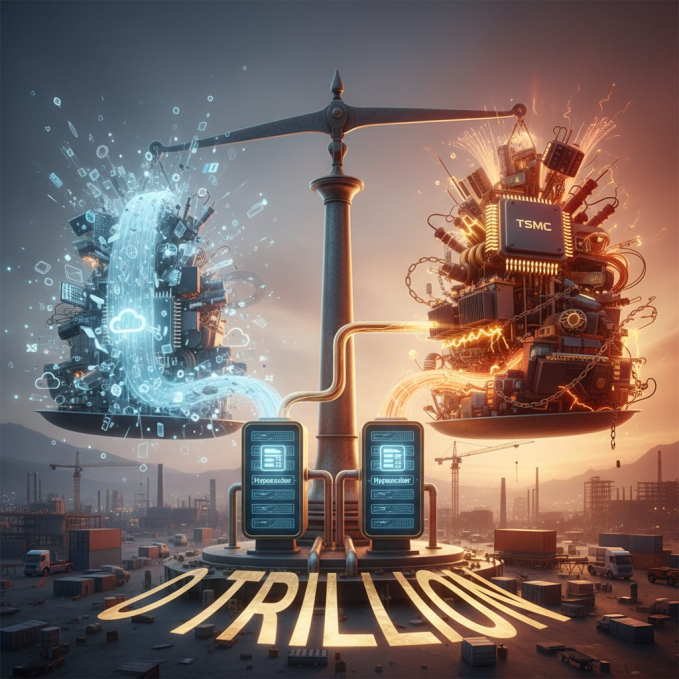
The real story is a $90 trillion shift from digital abundance (software that copies instantly) to physical scarcity (semiconductors, power infrastructure, optical fiber that takes years to build). And the hyperscalers aren't the winners in this story. They're just the funding vehicles.
"Ideas are now abundant," Visser notes. "Anything that you come up with as an idea, like software, comes to market immediately. But the death of software built on code is happening right now."
The 1970s Playbook Is Back. Materials, Energy, and Semiconductors Win.
Here's the historical parallel that matters: the 1970s.
In that decade, the bottleneck to economic growth wasn't innovation. It was physical resources. Energy crises. Materials shortages. Semiconductor scarcity. Companies that could secure physical capacity won enormous multiples.
We're entering that era again.
The difference: this time it's driven not by geopolitical disruption but by competitive necessity. Every hyperscaler is racing to build data center capacity for AI. Every company needs more semiconductors. Every grid is facing collapse from electricity demand.
Visser's portfolio thesis — built around power semiconductors, industrial materials, and optical infrastructure — is up 34% since November. The market is already pricing this in, but most investors are still looking at software multiples while physical infrastructure is just getting started.
The Hyperscaler Trap: They're Utilities, Not Growth Engines
This is the unintuitive part.
Microsoft cuts 7% of its workforce to fund AI spending. Meta is trimming headcount to pay for infrastructure. Amazon, Google — all of them are pouring cash into assets they can't monetize fast enough.
Visser calls this the transformation of hyperscalers from growth companies into infrastructure utilities.
They're still spending enormous amounts of capital. But those capital flows don't benefit hyperscaler shareholders. They benefit the companies selling the infrastructure to the hyperscalers.
"The hyperscalers are going to get hurt as well because they're depending on ROIC and adoption," Visser explains. "Meta, Microsoft looking to pay for their AI spending by trimming workforces."
The trade implication is stark: short hyperscalers, long the companies they're forced to buy from.
The 800-Volt DC Architecture Signal
One detail in the analysis jumped out as genuinely important.
Nvidia has reportedly visited Korean power equipment companies asking them to design data center infrastructure around an 800-volt DC architecture. This isn't a minor engineering tweak. This is a fundamental rethink of how power flows through a data center.
Why? Because data center electricity consumption is projected to double, and there's "just no way to build the infrastructure fast enough" with traditional approaches.
When the world's most powerful semiconductor company is personally visiting power companies requesting custom infrastructure, you're watching a scarcity premium form in real-time.
This creates enormous opportunity in power semiconductors — the chips that manage that 800-volt distribution. Every new data center will need complete electrical system redesigns. This is a multi-year buildout driven by competitive necessity, not discretionary spending.
Edge AI: The Next $50 Trillion Opportunity
Most investors are fixated on data center buildout. Visser points to something bigger: edge AI.
When Texas Instruments talks about "edge AI in all devices," they're describing a semiconductor content explosion in everything — cars, industrial equipment, robots, building systems.
Edge AI requires different chips than data center GPUs. It requires CPUs, microcontrollers, power management semiconductors. New winners. New supply chains. Multi-year scarcity in different semiconductor nodes.
"AI workloads are starting to penetrate industrial and edge form factors — meaning robots, test equipment, building systems, industrial vehicles," Visser notes.
This is pre-first inning. Current valuations don't reflect the magnitude of this opportunity because most investors are still thinking about ChatGPT running in the cloud, not AI running on every device.
The Trade Structure: Long Scarcity, Short Abundance
If you accept Visser's thesis, the trading structure is straightforward:
Long:
- Power semiconductors (scarcity premium on 800V buildout)
- Optical fiber companies (data center networking)
- Industrial materials and commodities (supply constraints)
- Semiconductor equipment makers (capacity bottleneck)
- Edge AI infrastructure plays
Short:
- Hyperscalers (utilities with declining returns)
- Software companies with code-based moats (commoditization)
- Companies dependent on cloud margin expansion
Volatility expectation: 30–50% swings, but within an uptrend that's barely started.
Specific options strategies Visser highlights:
- Long call spreads on power semiconductors — leveraged upside exposure with limited downside
- Short put spreads on hyperscalers — collect premium while waiting for multiple compression
- Long straddles on industrial commodities — capture upside from supply shortage events
The Risk: Inflation Could Disrupt, But Won't Derail
One legitimate concern: inflation above 4% could trigger Fed concerns and cause the market to pull back.
But here's the nuance: this infrastructure buildout is driven by competitive necessity, not financial engineering. If inflation rises, companies still have to build. They still need the semiconductors. The Fed can't stop physics — and the physics of AI requires more power, more chips, more fiber.
Inflation might cause volatility. It won't derail the buildout.
What This Means for Your Portfolio
If Visser is right — and his 34% YTD return suggests the thesis is already being validated — then:
- Software multiples are vulnerable to further compression. The narrative that "AI will save software companies" is getting tested against the reality that AI commoditizes software.
- Hyperscaler valuations are stretched relative to their transformation into infrastructure utilities. The old growth narrative doesn't hold.
- Physical infrastructure companies are in the early innings of a multi-year scarcity premium. The capex numbers are real ($90 trillion over decades), and they're accelerating.
- Semiconductors aren't one trade — there's differentiation between data center plays (GPU suppliers) and edge/power plays (microcontroller and power management suppliers).
- The geopolitical battle over TSMC and semiconductor capacity will intensify, creating volatility but also pricing in scarcity premiums.
The Shift Is Happening Now
The pattern Visser identifies — when CEOs use language like "physical upgrade" and cite specific spending targets — is the signal to follow the capex, not the buzzwords.
Microsoft, Google, Amazon, Meta — all of them are redirecting cash toward physical infrastructure. That's not a temporary cycle. That's a structural shift.
And when structural shifts happen, the companies that benefit aren't always the obvious ones. Hyperscalers seem like obvious winners. But if they're just funding vehicles for infrastructure companies, the real winning trade is owning the things they're forced to buy.
This is reporting on Jordi Visser's institutional analysis. Nothing here is financial advice. Consult a licensed advisor before making investment decisions.
Lisa Tamati reports on macro, investing, and technology at PTLsignal.com.
// newsletter
Want more like this?
Join the PTL Signal newsletter. Weekly AI, Bitcoin & market analysis from Lisa Tamati.