Jordi Visser & Anthony Pompliano: The AI Agent Economy Just Flipped Bitcoin & Eli Lilly's Value Proposition
Lisa Tamati reporting on Jordi Visser — Wall Street veteran and macro investor at the nexus of AI, investing, and macro — and Anthony Pompliano discussing the markets and AI.
There Are More AI Agents Online Than Humans Now. Everything Changes.
Bitcoin just crashed 50%. And nobody's talking about the real story.
It's not a bear market. It's an inflection point.
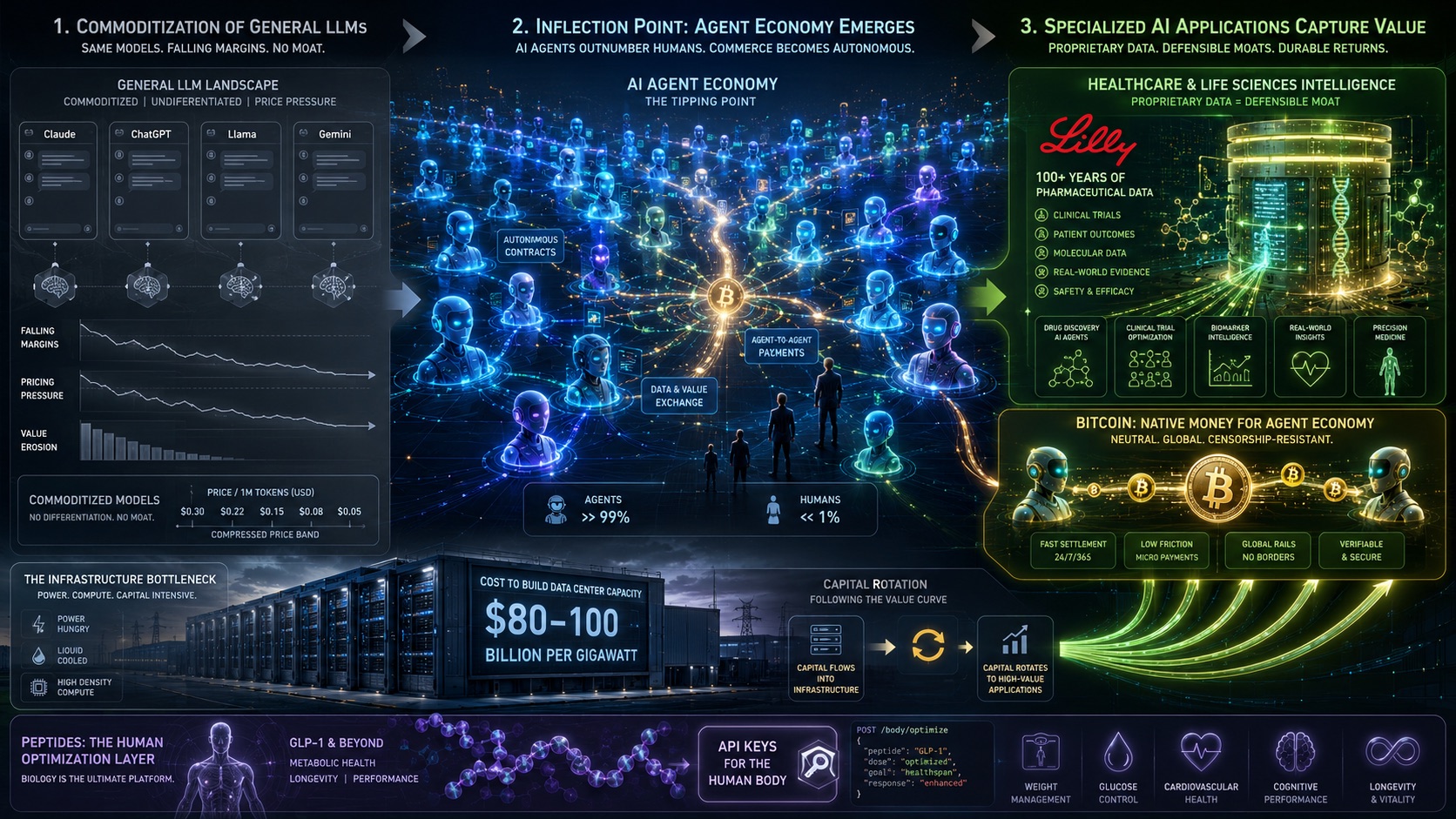
The underlying shift is from generalized AI models (ChatGPT, Claude) to specialized applications (Eli Lilly's proprietary healthcare models, agent-specific platforms). And the emergence of AI agents as the dominant economic participants online.
"There are more AI agents on HTML sites than humans. This is where we're headed."
When synthetic entities outnumber human users, the economic infrastructure changes. And Bitcoin becomes something it's never been before: digital currency for agent-to-agent transactions.
The LLM Commoditization Trap Nobody's Pricing In
Anthropic, OpenAI, and Google have built incredible general-purpose language models.
They're also becoming worthless.
"The LLMs are now commoditized. The price is not zero, but the difference between Claude and ChatGPT is indistinguishable to me."
This is the death knell for LLM-as-a-service companies. When every model is "good enough," the marginal value of incremental improvements collapses. Pricing power evaporates. Margins compress.
Meanwhile, enterprises are already gaming the system. Token optimization, edge computing, and local inference reduce API calls and threaten providers' revenue models.
The real money isn't in building better general models. It's in specialized applications.
Eli Lilly: The Hidden AI Supercompany
While the market obsesses over NVIDIA and semiconductor capex, Eli Lilly is quietly assembling the most defensible AI moat in existence.
Here's what they have:
- Proprietary data: 100+ years of pharmaceutical research, patient data, clinical trial results, molecular biology datasets. No competitor can replicate this.
- Specialized AI: Custom language models trained on proprietary healthcare data, creating models that are genuinely superior to ChatGPT at drug discovery, patient matching, and clinical workflows.
- Revenue today: GLP-1 peptides (Ozempic, Mounjaro) generating billions in revenue, with data points showing Victoria's Secret up 47% on GLP-1 demand signals.
- Infrastructure: Building their own data centers and Nvidia partnerships, not dependent on external compute suppliers.
- Vertical integration: From research through manufacturing through distribution, with AI optimizing every step.
Visser's thesis: Eli Lilly could become the world's largest AI company within 5 years.
This isn't speculation. It's pattern recognition on what actual AI value looks like—defensible moats, proprietary data, real revenue, specialized superior models.
The Infrastructure Bottleneck That's About to Matter
Data center costs just inflated dramatically.
"A data center for 1 gigawatt has gone from 50 billion to 60-80 billion. Jensen Huang said at Computex this weekend it'll very quickly be 80 to 100 billion."
$80-100 billion per gigawatt.
And here's the problem: "At these costs for the gigawatts, they're not going to be able to make the revenues."
This signals a critical inflection: AI infrastructure is getting so expensive that the capex ROIs are compressing. When a $100 billion facility needs to generate multi-billion-dollar annual revenues to justify the investment, suddenly you're constrained by actual demand.
This creates a rotation opportunity: Out of infrastructure plays (chips, data centers) and into application companies that monetize the infrastructure (Eli Lilly, specialized AI software, agent platforms).
The infrastructure bubble becomes obvious when buildout costs exceed achievable revenues.
Peptides as the Human Body's API Keys
This is the genuinely novel insight buried in the analysis.
"Peptides are the API key for the human body."
GLP-1 peptides (Eli Lilly's Mounjaro, Novo Nordisk's Ozempic) are the application layer for human optimization. They're not infrastructure. They're revenue-generating applications of biochemistry + AI optimization.
"GLP-1s are a little scary to people, but peptides everyone seems to be migrating towards."
The market is moving beyond generalized peptides into specialized peptide therapies optimized with AI. And Eli Lilly has the proprietary data, manufacturing, and AI capabilities to dominate this layer.
This is why the investment thesis is so powerful: Eli Lilly is AI + applications + revenue + data moats + peptides (the actual value layer for human optimization).
It's not a pharma company with AI features. It's an AI company that happens to be selling life-changing drugs.
Bitcoin: From Speculative Asset to Agent Economy Infrastructure
Bitcoin just crashed 50% with volatility compressing.
This is not the same as previous crashes (FTX panic, regulatory fears, panic selling).
"This 50% crash has occurred with volatility collapsing. Bitcoin's bleeding like 2% a week. It's not going down 15% in one day anymore."
What does this mean?
Asset maturation. Bitcoin is evolving from speculative casino asset into infrastructure. Institutional accumulation during declines. Orderly distribution. No panic.
And in an agent-dominated economy, Bitcoin becomes something new: native digital currency for synthetic entities.
Agents don't use bank accounts. They don't do ACH transfers. They need trustless, instant, 24/7 settlement infrastructure.
Bitcoin is that infrastructure.
"If you think the world of human beings is going to dominate commerce, it's not. It's AI agents."
When agents outnumber humans in commerce (and they're already outnumbering humans online), Bitcoin's addressable market expands from "alternative currency for humans" to "primary currency for machines."
This reframes Bitcoin accumulation during weakness not as speculative conviction, but as positioning for agent economy infrastructure.
The Trade Structure
Specialized AI models > general LLMs
Application revenue > infrastructure buildout
Agent-native infrastructure > human-first platforms
Eli Lilly Bull Call Spread (The Core AI Position)
- Structure: Buy $950 calls, sell $1100 calls, 6-month expiry
- Max Profit: $150 per spread minus net debit
- Max Loss: Net debit paid
- Breakeven: $950 + net debit
This captures LLY's upside as the market recognizes it as the specialized AI play with real revenue and defensible moats. The 6-month timeframe gives earnings visibility to prove the thesis.
Bitcoin Put Spreads (Accumulation Strategy)
- Structure: Sell $50k puts, buy $45k puts on MSTR or Bitcoin ETFs, 60-90 DTE
- Max Profit: Net credit received
- Max Loss: $5,000 minus net credit
- Breakeven: $50,000 minus net credit
This generates income while providing entry points if Bitcoin continues lower. The compressed volatility and orderly decline support accumulation thesis for agent economy exposure.
AI Software Bear Put Spread (Commodity Model Short)
- Structure: Buy $25 puts, sell $20 puts on general AI software names, 90-120 DTE
- Max Profit: $5 minus net debit
- Max Loss: Net debit paid
- Breakeven: $25 minus net debit
This captures the commoditization of general LLM companies as margins compress and token optimization accelerates. Specialized companies with moats win; generalized models lose.
What This Means
The Bitcoin 50% crash + LLM commoditization + Eli Lilly's emergence = a complete reordering of AI investment.
The old thesis: Buy infrastructure (chips, data centers) because AI capex is infinite.
The new thesis: Buy specialized applications with defensible moats (Eli Lilly), accumulate Bitcoin for agent economy infrastructure, rotate out of generalized LLM providers.
Three critical inflection points converging:
- LLMs becoming commodities — Pricing power collapses for general models
- Infrastructure costs exceeding revenues — $80-100B data centers need multi-billion annual returns to justify
- AI agents outnumbering human users — Economic transactions shift from human-to-human to agent-to-agent
When these converge, the value redistribution is massive:
Away from: GPU makers, data center operators, frontier model companies
Toward: Domain-specific AI with proprietary data (Eli Lilly), agent economy infrastructure (Bitcoin), specialized AI software
Eli Lilly isn't just a pharma stock with AI. It's the most defensible AI play in existence: proprietary data, specialized models, real revenue, vertical integration, and peptides as the application layer for human optimization.
And Bitcoin, beaten down 50%, transforms from speculative asset into the settlement infrastructure for a commerce system dominated by synthetic entities.
Important Disclaimer
- This is analysis of macro conversations, not financial advice
- All trade ideas are hypothetical and educational
- Options strategies carry significant risk
- LLM commoditization may reverse if new breakthroughs occur
- Infrastructure costs could be justified by higher token demand
- Bitcoin's agent economy thesis is speculative
- GLP-1 supply chain disruptions could derail the LLY thesis
- Quantum computing could threaten Bitcoin's cryptographic foundation
- Consult a licensed financial advisor before trading
- Past performance doesn't guarantee future results
Lisa Tamati reports on AI, specialized applications, and market inflection points at PTLsignal.com
// newsletter
Want more like this?
Join the PTL Signal newsletter. Weekly AI, Bitcoin & market analysis from Lisa Tamati.